JB Insights
Why Israel’s Election Is Rippling Through Gold, Oil, and Capital Markets
The Immediate Channel Connecting Electoral Politics To Precious Metals Is The Market’s Assessment Of Regional Stability Across The Middle East.


When citizens cast their ballots in a tightly contested general election, the focus is naturally on parliamentary seats, coalition alignments, and domestic policy. But in today’s deeply interconnected global economy, the reverberations of a high-stakes national vote rarely stop at national borders.
Look no further than the commodities trading desks in London, New York, and Mumbai: as election results trickle in, spot gold continues to hold firm above the historic $4,000 per ounce milestone, keeping investors on high alert.
At first glance, linking a country’s legislative election directly to global bullion prices might seem like a stretch. Yet, for gold and silver, the election isn’t merely about who occupies the Prime Minister’s office—it is about the indirect geopolitical and macroeconomic waves that follow.
1. Geopolitical Risk Premiums: The Safe-Haven Calculus
The immediate channel connecting electoral politics to precious metals is the market’s assessment of regional stability across the Middle East.
- Prolonged Deadlock or a Netanyahu Victory: Markets tend to price in a continuation—or even an escalation—of a firm military stance regarding regional conflict points and tensions with Iran. For global traders, this lingering friction translates into sustained safe-haven demand, keeping a firm floor under gold prices.
- An Opposition Shift: Conversely, a victory by an opposition bloc (led by figures such as Gadi Eisenkot) is often interpreted by international markets as potentially easing immediate regional geopolitical friction. Should risk premiums recede, safe-haven assets could experience minor profit-taking or stabilizing pressure.
However, political headlines are only one piece of a much larger economic puzzle.
2. Energy, Inflation, and Shipping Corridors
Electoral outcomes carry subtle yet direct implications for global energy flows. When political shifts influence expectations surrounding crucial shipping routes—such as the Strait of Hormuz—crude oil markets react instantly.
Fluctuations in oil prices spill directly into global inflation expectations. Rising energy costs complicate central bank targets worldwide, reinforcing gold’s historic role as a premier hedge against persistent inflationary pressure.
3. The Real Drivers: The Fed, the Dollar, and Bond Yields
While political headlines grab attention, macro forces remain the ultimate drivers of gold’s long-term trajectory. Precious metals rarely move in a vacuum; they respond aggressively to monetary policy, U.S. Treasury yields, and currency swings.





JB Insights
Gold Rate-Locking and Advance-Booking Ahead Of Dhanteras 2026
The Strategy Is To Mitigate The Impact Of Heightened Price Volatility and Recent Bullion Price Corrections On Consumer Sentiment
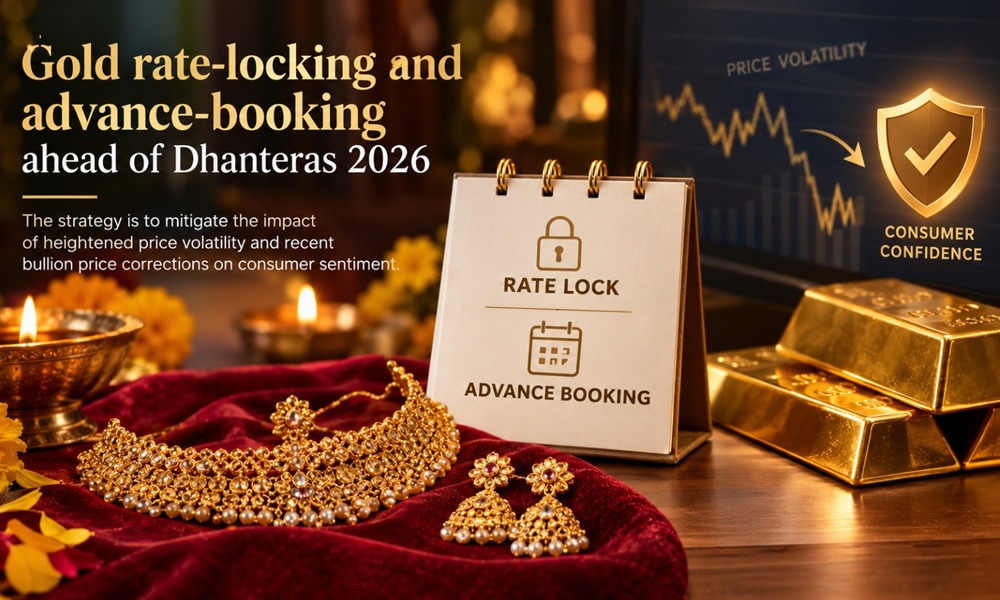
Ahead of Dhanteras on November 6, 2026, Indian jewellery retailers are aggressively leveraging advance-booking and gold rate-locking schemes to mitigate the impact of heightened price volatility and recent bullion price corrections on consumer sentiment.
Following subdued sales during Dussehra, retailers are banking on the dual convergence of Dhanteras and the upcoming wedding season to drive robust revenue recovery. Leading national and regional brands report optimistic projections, bolstered by strong interest in both heavy bridal pieces and budget-conscious solutions like lightweight jewellery and old-gold exchanges.
1. Market Context & Bullion Price Trends
Recent gold and silver trading ranges reflect elevated price levels driven by ongoing global geopolitical uncertainty, sustained central-bank purchases, and fluctuations in international currency markets.
- Gold Prices: Standard 10-gram rates are hovering between Rs 1.42 lakh and Rs 1.44 lakh.
- Silver Prices: Standard 1-kilogram rates range from Rs 1.95 lakh to Rs 1.96 lakh.
While high prices have created initial friction, recent price corrections have provided an entry window for consumers, encouraging advance commitments ahead of expected festive demand spikes.
Retail Outlook & Strategic Schemes
To capitalize on festive tailwinds and hedge consumers against potential price surges, major retailers—including Kalyan Jewellers, Joyalukkas, Senco Gold & Diamonds,—have deployed price-protection mechanisms.
Rate-Locking Mechanisms
Advance-booking schemes allow buyers to reserve jewellery by locking in current gold prices. If prices rise before final delivery, consumers pay the lower locked-in rate; if prices decline, consumers benefit from the lower market price at the time of final settlement.
Consumer Buying Patterns & Product Demand
Rising gold rates are bifurcating consumer preferences into two distinct buying trends:
High-Value Bridal & Heritage Segment
Wedding-related purchasing remains a resilient anchor for the market. Consumers continue to allocate budgets toward high-ticket items, including:
- Heavy Gold Pieces: Essential traditional bridal sets.
- Heritage & Polki Work: Intricate traditional craftsmanship.
- Diamond Jewellery: Increasingly favored in modern bridal trouseaus.
Budget Management & Value Optimization
To offset high unit costs for non-wedding or casual festive purchases, consumers are adjusting their buying strategies:
- Lightweight Jewellery: Lower overall grammage to fit fixed budget caps.
- Old-Gold Exchanges: Recycling existing family holdings into contemporary designs.
Key Insight: Senco Gold reported that old-gold exchanges now account for more than 50% of its overall business, underscoring exchange programs as the single most critical driver of sales enablement during high-price regimes.
Operational Outlook & Risks
The immediate business outlook for Indian jewellery retailers hinges on execution during the final days leading up to Dhanteras and the subsequent wedding peak:
- Conversion Metrics: The final festive revenue numbers will depend on the successful conversion rate of advance bookings into finalized, fulfilled sales.
- Margin Protection: While rate-locking drives volume, unhedged price movements pose minor margin risks for smaller retailers lacking robust bullion hedging practices.
- Inventory Management: Retailers must balance inventory stocks between high-margin bridal inventory and fast-moving, lightweight everyday wear.
Indian jewellery retailers are entering the Dhanteras 2026 period with high expectations, relying on structural price-protection tools to overcome earlier seasonal slumps. As advance bookings build momentum, old-gold recycling and rate-locking schemes are effectively bridging the gap between record-high bullion prices and strong consumer appetite for seasonal gold accumulation.



MCX Gold Futures Trade Near ₹1.42 Lakh Amid Dollar Strength and Fed Rate Cues

Why Israel’s Election Is Rippling Through Gold, Oil, and Capital Markets

Gargi By P N Gadgil & Sons Invites Women To #GETNOTICED This Diwali In New Campaign With Mithila Palkar

Dhanteras Shopping Guide 2026:Gold, Silver, Diamonds & Festive Jewellery Trends To Watch

The Solenne Collection: A Celebration Of Diwali By Bharti Bangur Fine Jewels

From Diya Puja To Diwali Soirées: Jewellery Designed To Go Beyond The Festive Season
-
 JB Insights5 days ago
Dhanteras Shopping Guide 2026:Gold, Silver, Diamonds & Festive Jewellery Trends To Watch
-
 BrandBuzz5 days ago
The Solenne Collection: A Celebration Of Diwali By Bharti Bangur Fine Jewels
-
 BrandBuzz5 days ago
From Diya Puja To Diwali Soirées: Jewellery Designed To Go Beyond The Festive Season
-

 National News5 days ago
Indriya, Aditya Birla Jewellery Unveiled India’s Largest Sustainable Jewellery Rangavalli