

International News
GJ exporters hasten US shipments amid tariff uncertainty

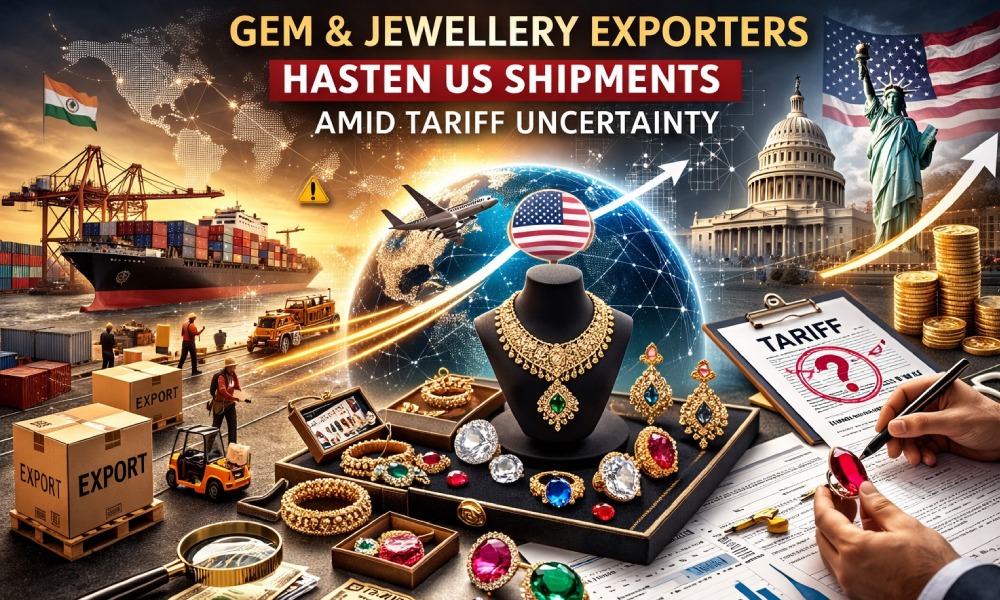
Following a landmark US Supreme Court ruling on February 20, 2026, which invalidated President Trump’s “reciprocal tariffs” under the International Emergency Economic Powers Act (IEEPA), the trade landscape has shifted into a volatile transition period. In response, the US administration has invoked Section 122 of the Trade Act of 1974, implementing a temporary 15% global import surcharge.
Indian exporters in various sectors including GJ are currently racing to maximize shipments within a 150-day window to capitalize on the relative certainty of the current 15% rate before potential further escalations under Section 301. The “150-day window” (ending roughly in July 2026) has become a critical marathon for Indian logistics. While the Supreme Court ruling offered a brief moment of relief by striking down 50% “penalty” duties, the immediate reimposition of a 15% surcharge keeps the “landed cost” of Indian goods high.
Gems and Jewellery sector impact
- Current Status: The sector is reeling from a 60% year-on-year decline in cut and polished diamond exports (falling from $3.64 billion to $1.45 billion in the April–December 2025 period).
- Exporter Action: The Gem & Jewellery Export Promotion Council (GJEPC) successfully requested Mumbai Customs to remain open over the weekend to facilitate immediate dispatches.
- Trade Deal Outlook: Under a recently announced interim framework, India expects zero-duty access for diamonds and a reduction in jewellery tariffs to 18% (down from 25%). Exporters are rushing to ship goods before these negotiated terms are potentially complicated by the new Section 122 surcharge.
Technical Regulatory Framework
The shift in US policy utilizes two distinct legal “hammers”:
| Regulation | Status | Impact on Indian Exporters |
| IEEPA (Reciprocal Tariffs) | Invalidated | Struck down by SCOTUS (6-3); provides legal grounds for potential duty refunds. |
| Section 122 (Trade Act 1974) | Active | 15% surcharge for a maximum of 150 days to address balance-of-payments deficits. |
| Section 301 | Threatened | Allows USTR to impose punitive tariffs for “unfair” trade practices; seen as a looming risk. |
Strategic Outlook
The “150-day window” (ending roughly in July 2026) has become a critical marathon for Indian logistics. While the Supreme Court ruling offered a brief moment of relief by striking down 50% “penalty” duties, the immediate reimposition of a 15% surcharge keeps the “landed cost” of Indian goods high.
Note: Exporters are urged to maintain close coordination with the Union Commerce Ministry, as the operationalization of the India-US Interim Trade Pact (expected in April 2026) may offer a “carve-out” or preferential rate that bypasses the global 15% surcharge.


International News
Swiss International Gemlab Launches with Proprietary AI for Precise Colored Gemstone Grading
Swiss International Gemlab promises Faster, More Accurate Certification, Ensures Report Consistency

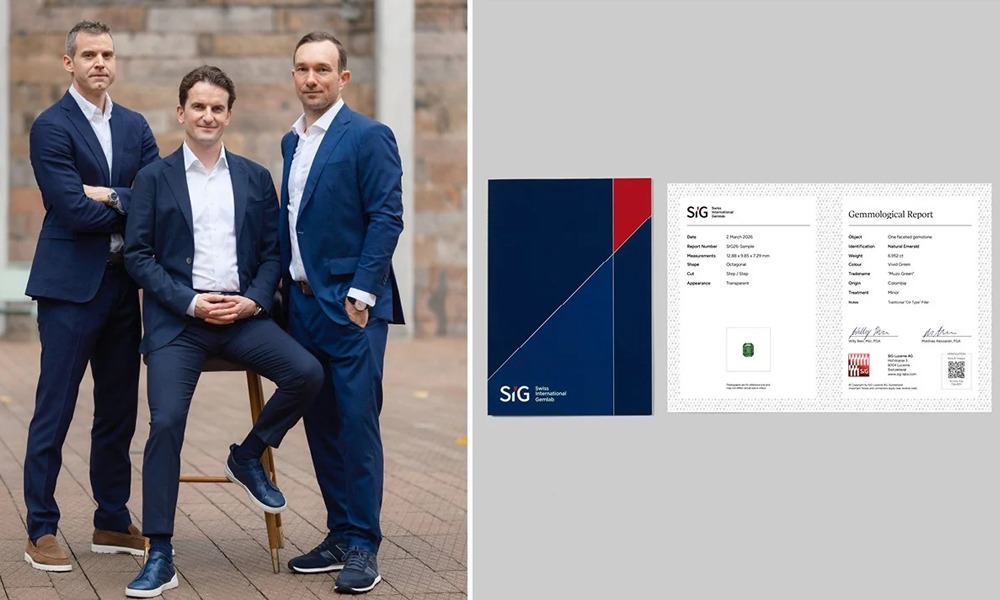
Three veteran gemologists today announced the opening of Swiss International Gemlab (SIG), a cutting-edge facility leveraging proprietary artificial intelligence (AI) to enhance grading accuracy and consistency for colored gemstones.
Founded by Willy Bieri, Lawrence Hahn, and Matthias Alessandri—senior experts who have collaborated for over a decade—SIG will operate from state-of-the-art locations in Lucerne, Switzerland, and Hong Kong. The lab promises faster results, unmatched transparency, and scientific rigor, insulated from external influences.
SIG delivers a full spectrum of services, including gemstone identification, origin determination, treatment analysis, and advanced color grading. At its core is SIG-AI Assistance, a proprietary system that cross-references analytical data against structured databases to detect anomalies, ensure report consistency, and slash interpretation time.
With a standard turnaround of five business days—plus expedited options for urgent needs—and real-time status tracking, SIG sets a new benchmark for efficiency and reliability in gem certification. The lab will make its global debut at this year’s GemGenève in May, offering on-site services to industry professionals.


-

 International News2 days ago
Precious Metals Rally On US-Iran Ceasefire: Gold Tops $4,850, Silver Jumps To $76
-

 National News11 hours ago
KISNA Diamond and Gold Jewellery Unveils Akshaya Tritiya Campaign
-
 National News22 hours ago
Gargi by P. N. Gadgil & Sons Posts 30.27% Revenue Growth in Q4FY26
-
 National News18 hours ago
P N Gadgil Jewellers Limited – Quarterly Update Q4 FY26
