
International News
GJ exporters hasten US shipments amid tariff uncertainty

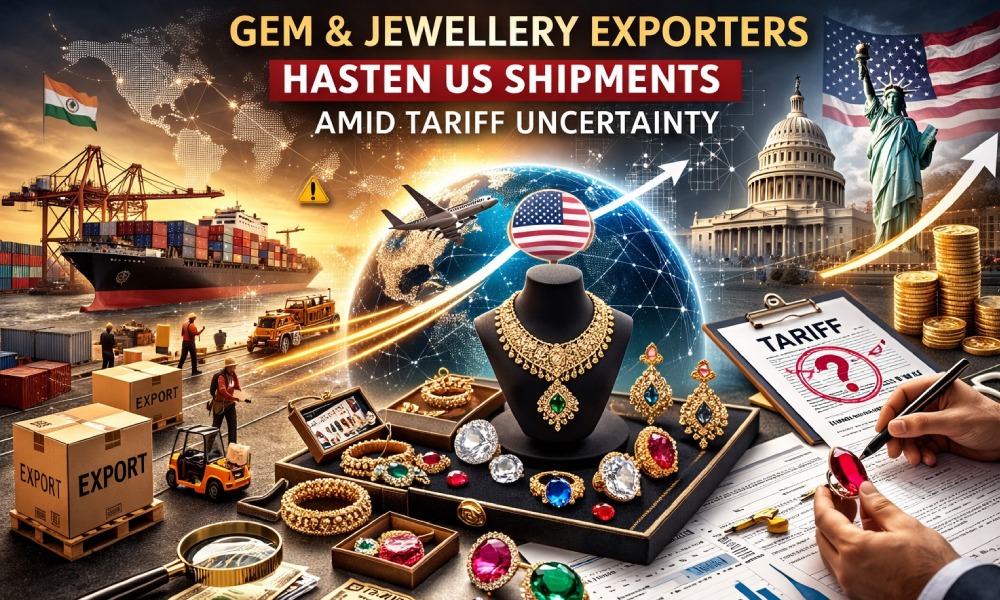
Following a landmark US Supreme Court ruling on February 20, 2026, which invalidated President Trump’s “reciprocal tariffs” under the International Emergency Economic Powers Act (IEEPA), the trade landscape has shifted into a volatile transition period. In response, the US administration has invoked Section 122 of the Trade Act of 1974, implementing a temporary 15% global import surcharge.
Indian exporters in various sectors including GJ are currently racing to maximize shipments within a 150-day window to capitalize on the relative certainty of the current 15% rate before potential further escalations under Section 301. The “150-day window” (ending roughly in July 2026) has become a critical marathon for Indian logistics. While the Supreme Court ruling offered a brief moment of relief by striking down 50% “penalty” duties, the immediate reimposition of a 15% surcharge keeps the “landed cost” of Indian goods high.
Gems and Jewellery sector impact
- Current Status: The sector is reeling from a 60% year-on-year decline in cut and polished diamond exports (falling from $3.64 billion to $1.45 billion in the April–December 2025 period).
- Exporter Action: The Gem & Jewellery Export Promotion Council (GJEPC) successfully requested Mumbai Customs to remain open over the weekend to facilitate immediate dispatches.
- Trade Deal Outlook: Under a recently announced interim framework, India expects zero-duty access for diamonds and a reduction in jewellery tariffs to 18% (down from 25%). Exporters are rushing to ship goods before these negotiated terms are potentially complicated by the new Section 122 surcharge.
Technical Regulatory Framework
The shift in US policy utilizes two distinct legal “hammers”:
| Regulation | Status | Impact on Indian Exporters |
| IEEPA (Reciprocal Tariffs) | Invalidated | Struck down by SCOTUS (6-3); provides legal grounds for potential duty refunds. |
| Section 122 (Trade Act 1974) | Active | 15% surcharge for a maximum of 150 days to address balance-of-payments deficits. |
| Section 301 | Threatened | Allows USTR to impose punitive tariffs for “unfair” trade practices; seen as a looming risk. |
Strategic Outlook
The “150-day window” (ending roughly in July 2026) has become a critical marathon for Indian logistics. While the Supreme Court ruling offered a brief moment of relief by striking down 50% “penalty” duties, the immediate reimposition of a 15% surcharge keeps the “landed cost” of Indian goods high.
Note: Exporters are urged to maintain close coordination with the Union Commerce Ministry, as the operationalization of the India-US Interim Trade Pact (expected in April 2026) may offer a “carve-out” or preferential rate that bypasses the global 15% surcharge.


International News
GJEPC Promotes Key Trade Events At IGI Dubai Event
The Dubai Event Created Opportunities For Participating Indian Exporters To Connect Directly With Potential Buyers.

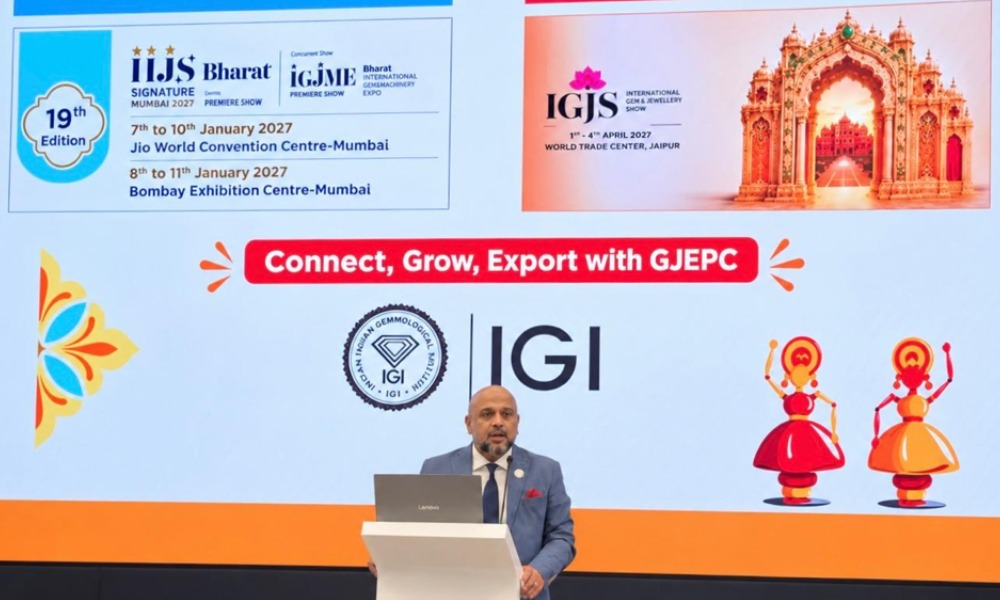
GJEPC stepped up its international buyer outreach for IIJS Bharat – Signature 2027, IGJS Jaipur and IJEX at an industry event organised by the International Gemological Institute (IGI) in Dubai.
Held at the Almas Tower Ballroom in Jumeirah Lake Towers, the IGI Ornamental QC Seminar brought together an audience of more than 70 jewellers, with leading retailers including Jawhara, Joyalukkas, Tajvi, Vinsmera, La Marquise, Bhima and Cara among the expected participants.
Ashish Sakhardande, Head – IJEX, GJEPC, represented the Council and delivered a presentation on its upcoming exhibitions and initiatives, placing particular emphasis on IIJS Bharat – Signature 2027, IGJS Jaipur and IJEX, highlighting its new features and inviting UAE buyers to register for the Mumbai and Jaipur shows.
The UAE remains an important market for Indian jewellery exporters, making direct engagement with retailers and jewellery companies a key part of the buyer mobilisation strategy.
The Dubai event created opportunities for participating Indian exporters to connect directly with potential buyers. Business meetings and networking interactions were facilitated with several UAE-based companies, allowing exporters participating through IJEX to develop new commercial contacts.



KISNA Diamond and Gold Jewellery Rolls Out Nationwide ‘Shop Sparkle Win’ Campaign Across 218 Cities, With 823 Vehicles Up For Grabs

Nemichand Bamalwa Creates Nav Avatar Necklace For Maa Durga At Indian Museum’s Durga Puja

Kangana Ranaut Unveils PNG Jewellers New Showroom In Ayodhya~

GGJS 2026 Concludes With High-Volume Trade and Strategic Focus On Next-Gen Leadership
Nemichand Bamalwa Creates Nav Avatar Necklace For Maa Durga At Indian Museum’s Durga Puja
KISNA Diamond and Gold Jewellery Rolls Out Nationwide ‘Shop Sparkle Win’ Campaign Across 218 Cities, With 823 Vehicles Up For Grabs
-
 National News5 hours ago
GGJS 2026 Concludes With High-Volume Trade and Strategic Focus On Next-Gen Leadership
-
 National News35 minutes ago
Nemichand Bamalwa Creates Nav Avatar Necklace For Maa Durga At Indian Museum’s Durga Puja
-
 National News26 minutes ago
KISNA Diamond and Gold Jewellery Rolls Out Nationwide ‘Shop Sparkle Win’ Campaign Across 218 Cities, With 823 Vehicles Up For Grabs
-
 New Premises4 hours ago
Kangana Ranaut Unveils PNG Jewellers New Showroom In Ayodhya~
