National News
AIJGF Proposes Regulated “Bullion Bank”, Proposal Presented Directly To Union Commerce and Industry Minister
Establishes A Centralized Financial Framework To Pool, Standardise, Settle, and Lease Domestic Gold

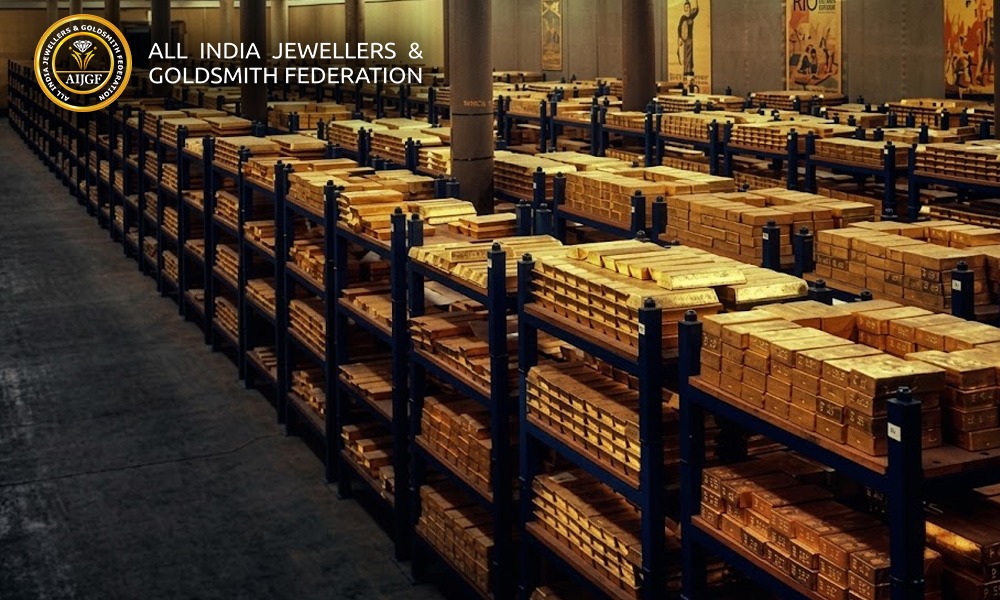
The Ministry of Commerce and Industry is officially reviewing a landmark proposal to establish a regulated “Bullion Bank” aimed at transforming India’s massive domestic gold reserves into an active economic asset.
The proposal was presented directly to Union Commerce and Industry Minister Piyush Goyal by a delegation from the All India Jewellers and Goldsmith Federation (AIJGF). In response, Minister Goyal has agreed to form a comprehensive consultation committee—comprising government representatives, jewellery industry stakeholders, bullion market experts, financial institutions, and market regulators—to thoroughly examine the framework.
Key Highlights of the Proposal:
- Activating Idle Wealth: Establishes a centralised financial framework to pool, standardise, settle, and lease domestic gold, significantly reducing India’s heavy reliance on expensive foreign imports.
- Tapping a $4 Trillion Market: Aims to mobilse the estimated 25,000 to 27,000 tonnes of gold held by Indian households, temples, and private institutions—a stockpile currently valued between $3.65 trillion and $4.3 trillion.
- Earning Interest on Gold: Transforms physical gold from a passive, non-yielding asset into an active, interest-earning investment, eliminating traditional locker storage fees for citizens.
- ETF Integration: Proposes allowing Gold Exchange-Traded Funds (ETFs) to lend 20–30% of their idle physical holdings back into the jewellery ecosystem under strict over-collateralised, insured, and daily marked-to-market safety protocols.
A Strategic Move for Economic Resilience
Currently, the vast majority of India’s gold wealth remains locked away and unproductive. By acting as a trusted intermediary, the proposed Bullion Bank will allow households and institutions to securely lend their gold back into the domestic jewellery ecosystem.
“This framework has the potential to permanently change how India manages its gold,” stated the AIJGF in their proposal. “By unlocking domestic reserves, we can stabilise the market, support local artisans, and strengthen the national economy.”
To ensure seamless execution and regulatory oversight, the AIJGF has also requested the creation of a dedicated inter-ministerial task force. This body would bring together the Ministry of Finance, the Ministry of Commerce, and the Ministry of Consumer Affairs to oversee the initiative’s roll-out.


– Kirit Bhansali, Chairman, GJEPC

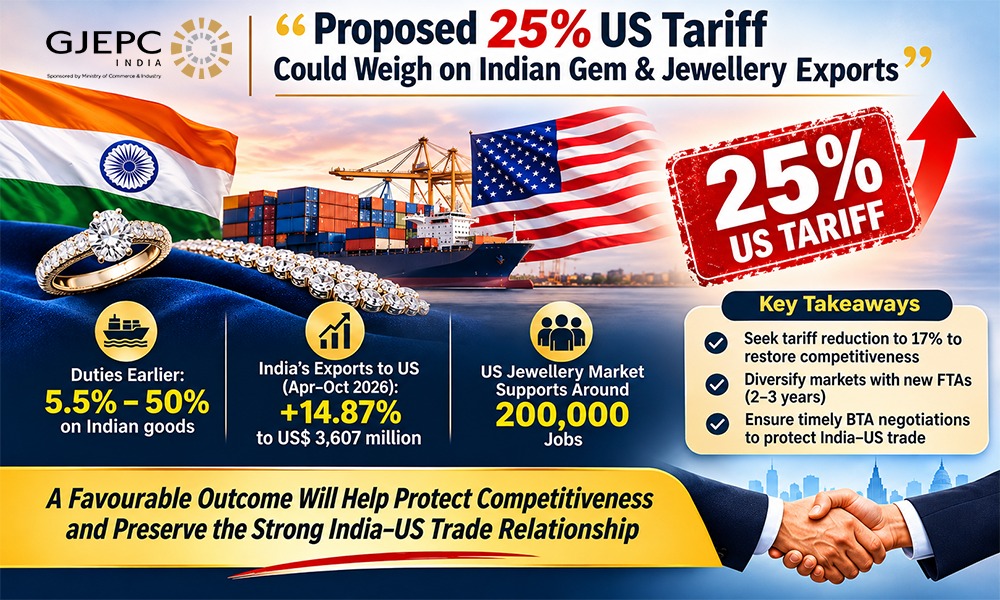
“India’s gem and jewellery sector has faced prolonged uncertainty from US tariff measures, with duties ranging from 5.5% to 50%, straining exports, payment cycles and logistics costs. Tariffs raise landed costs and retail prices, potentially dampening US consumer demand and affecting jobs and businesses across the value chain in both countries. The US remains a major jewellery market, supporting roughly 200,000 jobs.
Although the situation had begun to improve—with India’s gem and jewellery exports to the US growing 14.87% to US$3,607 million during April–October 2026 year-on-year—the proposed 25% US tariff on Indian goods could again weigh on the sector. Any increase in tariffs, or continued uncertainty over market access, would affect the competitiveness of Indian exports, disrupt order flows and compress exporters’ margins in this key market.
The industry is hopeful that the agreement will provide meaningful relief by reducing the tariff to 17%, restoring price competitiveness and creating a more favourable environment for exporters to sustain and grow their business in the US market.
While India’s new FTAs will help diversify export markets over time, building alternative buyer relationships could take two to three years, whereas the impact of proposed tariffs could be felt within 45 days to two months. Higher proposed tariffs on competitors such as Thailand, Vietnam and China may offer Indian exporters a relative advantage, though the benefit will depend on the final tariff structure. The industry remains resilient and hopeful that timely BTA negotiations will secure a favourable outcome, protect competitiveness and preserve the strong India–US trade relationship.”



The Architecture of Desire: Why True Luxury Lives In The Felt Experience By Dr. C. Vinod Hayagriv MD- C. Krishniah Chetty Group of Jewellers

GJEPC Quote On Proposed 25% Tariff By US

Make A Statement This Black Friday With Palmonas’ Top Jewellery Picks

5 Solitaire Mangalsutra Designs By Divine Solitaires For Every Style and Occasion
GJEPC Quote On Proposed 25% Tariff By US
The Architecture of Desire: Why True Luxury Lives In The Felt Experience By Dr. C. Vinod Hayagriv MD- C. Krishniah Chetty Group of Jewellers
-
 National News6 hours ago
5 Solitaire Mangalsutra Designs By Divine Solitaires For Every Style and Occasion
-
 National News5 hours ago
GJEPC Quote On Proposed 25% Tariff By US
-
 By Invitation3 hours ago
The Architecture of Desire: Why True Luxury Lives In The Felt Experience By Dr. C. Vinod Hayagriv MD- C. Krishniah Chetty Group of Jewellers
-
 National News6 hours ago
Make A Statement This Black Friday With Palmonas’ Top Jewellery Picks