
International News
50% tariffs on Indian gems and jewellery US jewellery – industry braces for disruption


The US jewellery industry is bracing for disruption following the Trump administration’s imposition of tariffs up to 50% on Indian gems, diamonds, and jewellery. The move poses a critical supply chain challenge ahead of the US holiday shopping season.
In response, US retailers have rushed to stockpile goods before the tariffs took effect, with Indian exporters rerouting large consignments to US-based warehouses. Simultaneously, sourcing diversification has accelerated: Israel and Belgium are emerging as alternatives for diamond cutting and polishing, Thailand and Vietnam for jewellery manufacturing, and Turkey and Italy for gold and silver pieces. Some retailers are also experimenting with domestic production or nearshoring to Mexico and Canada, though scalability remains limited.
Market analysts predict price increases of 20–40% on affected items. Retailers are expected to cushion demand shocks by promoting lab-grown diamonds—less reliant on Indian processing—and highlighting alternative gemstones like sapphires, emeralds, and rubies. Larger chains with robust inventories and brand equity, such as Tiffany & Co. and Signet Jewelers, are better positioned to absorb the disruption. Independent jewellers, however, face shrinking margins, reduced product variety, and heightened competition.
If tariffs remain in place into 2026, the industry could undergo a structural transformation. India’s dominance in diamond and jewellery supply chains may wane, replaced by a more fragmented, globally distributed model that elevates lab-grown diamonds and alternative sourcing hubs. This shift, while painful in the short term, could redefine the landscape of jewellery retail in the US.
The tariff move is not an isolated trade measure—it reflects escalating US-India tensions over energy imports and geopolitical alignment. In this context, diamonds and jewellery have become collateral damage in a wider trade war. Industry lobbying by groups such as the Jewelers of America may eventually secure carve-outs, but not before the 2025 holiday season takes its toll. If the tariffs persist, they could even discourage US retailers from expanding jewellery offerings, affecting employment in design, distribution, and retail.
Long-Term Structural Shifts
If India’s dominance erodes, the global jewellery industry could enter a new era defined by:
- Fragmented sourcing with multiple mid-sized hubs instead of one dominant supplier.
- Acceleration of lab-grown diamond adoption, positioning them as mainstream rather than niche.
- Changing consumer tastes, as higher prices push experimentation with alternative gemstones and contemporary jewellery design.
- Technological innovation, with AI-driven supply chain optimization, blockchain-based traceability, and 3D printing of jewellery parts playing a larger role in reducing dependency on single-source hubs.








International News
GJEPC Promotes Key Trade Events At IGI Dubai Event
The Dubai Event Created Opportunities For Participating Indian Exporters To Connect Directly With Potential Buyers.

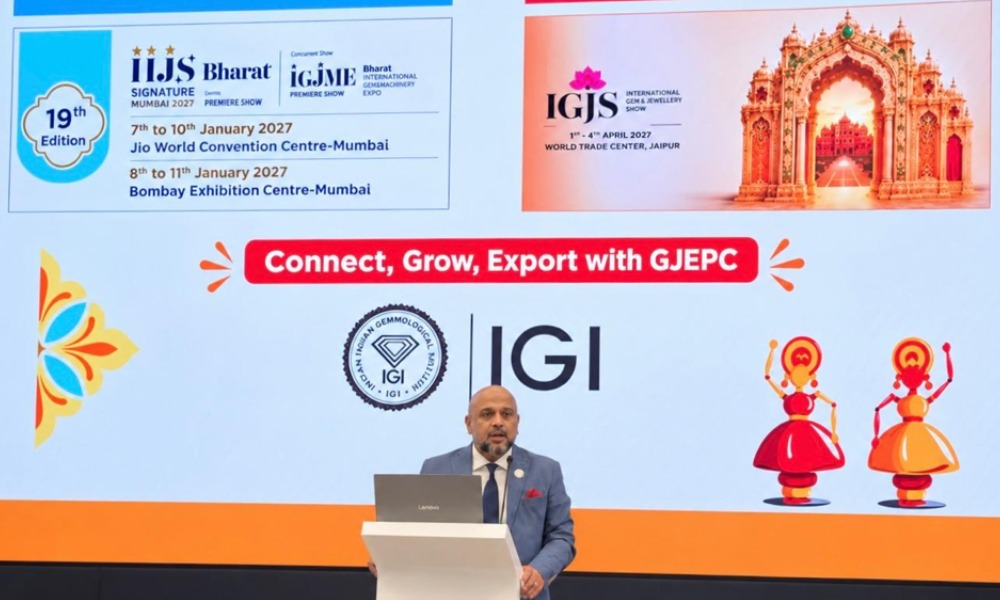
GJEPC stepped up its international buyer outreach for IIJS Bharat – Signature 2027, IGJS Jaipur and IJEX at an industry event organised by the International Gemological Institute (IGI) in Dubai.
Held at the Almas Tower Ballroom in Jumeirah Lake Towers, the IGI Ornamental QC Seminar brought together an audience of more than 70 jewellers, with leading retailers including Jawhara, Joyalukkas, Tajvi, Vinsmera, La Marquise, Bhima and Cara among the expected participants.
Ashish Sakhardande, Head – IJEX, GJEPC, represented the Council and delivered a presentation on its upcoming exhibitions and initiatives, placing particular emphasis on IIJS Bharat – Signature 2027, IGJS Jaipur and IJEX, highlighting its new features and inviting UAE buyers to register for the Mumbai and Jaipur shows.
The UAE remains an important market for Indian jewellery exporters, making direct engagement with retailers and jewellery companies a key part of the buyer mobilisation strategy.
The Dubai event created opportunities for participating Indian exporters to connect directly with potential buyers. Business meetings and networking interactions were facilitated with several UAE-based companies, allowing exporters participating through IJEX to develop new commercial contacts.



Focus Should Remain On Price Stability, Consumer Confidence and Healthy Jewellery Demand: GJC Comment On RBI Rate Hike Impact On Gold Prices

Natural Diamond Brand ZOORI Unveils Ambitious National Expansion Plan, Targets 25 Stores In A Year!

India–UK FTA: Opening A New Chapter For Indian Jewellery
Natural Diamond Brand ZOORI Unveils Ambitious National Expansion Plan, Targets 25 Stores In A Year!
Focus Should Remain On Price Stability, Consumer Confidence and Healthy Jewellery Demand: GJC Comment On RBI Rate Hike Impact On Gold Prices
India–UK FTA: Opening A New Chapter For Indian Jewellery
-
 National News18 minutes ago
Natural Diamond Brand ZOORI Unveils Ambitious National Expansion Plan, Targets 25 Stores In A Year!
-
 National News34 seconds ago
Focus Should Remain On Price Stability, Consumer Confidence and Healthy Jewellery Demand: GJC Comment On RBI Rate Hike Impact On Gold Prices
-
 JB Insights2 hours ago
India–UK FTA: Opening A New Chapter For Indian Jewellery
-

 National News2 hours ago
Navigating Gold Loans During Repo Rate Hikes
