National News
Will RBI Rate Hikes Make Gold Loans Costlier?
With Bullion rIces Sliding From Recent Peaks, Borrowers Face A Dual Squeeze: Potential Upward Adjustments On Floating Borrowing Costs and Lower Loan Amounts Against Pledged jJewellery.

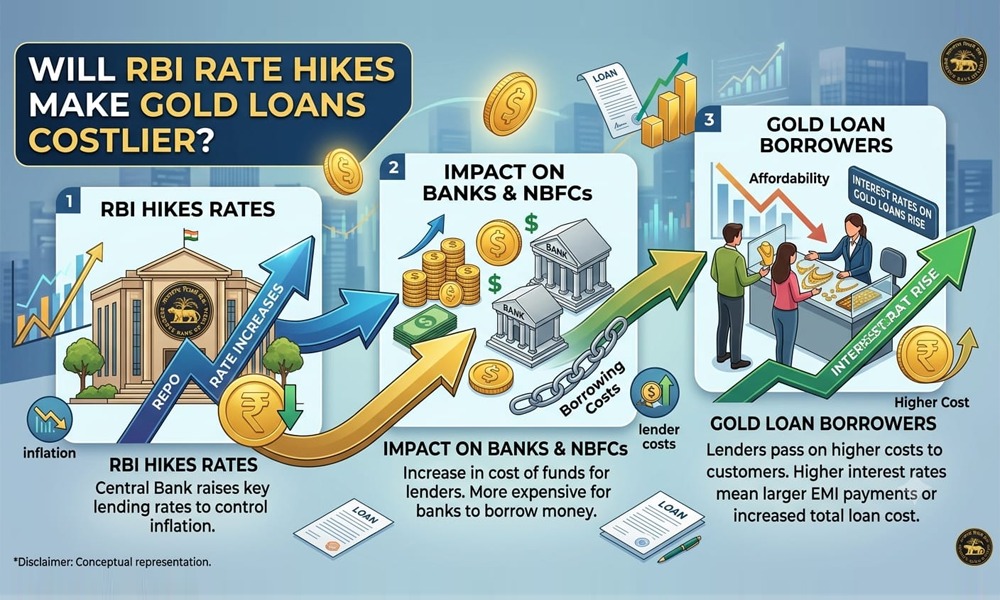
Potential rate hikes by the Reserve Bank of India (RBI) could push borrowing costs higher across the financial system, but the transmission to gold loans will not be immediate or uniform across all lenders, analysts and industry executives said. With bullion prices sliding from recent peaks, borrowers face a dual squeeze: potential upward adjustments on floating borrowing costs and lower loan amounts against pledged jewellery.
Key Takeaways for Borrowers & Lenders
Non-Uniform Transmission: A repo rate hike does not guarantee a 1:1 surge in gold loan rates. Lenders pricing credit via non-bank finance company (NBFC) cost-of-funds channels may adjust rates on a different timeline compared to banks operating direct floating-rate transmission models.
Loan Structure Matters: Existing fixed-rate borrowers remain protected for their contract term, while floating-rate borrowers face higher interest costs upon contract reset dates.
Collateral & LTV Risk: A fall in gold prices reduces the value of pledged collateral relative to total debt. Lenders are required under RBI regulations to enforce a strict loan-to-value (LTV) ceiling of 75%, leaving borrowers vulnerable to margin calls or mandatory partial pay-downs if market prices breach regulatory margins.
Commercial banks experience a high and direct immediate impact from a central bank rate hike, as their benchmark-linked External Benchmark Lending Rates (EBLR) force floating borrowing costs to reset quickly.
In contrast, gold loan NBFCs face a moderate or delayed impact, with interest rate adjustments depending on their broader liability structure, wholesale borrowing costs, and competitive market positioning.
For fixed-rate contracts, a rate hike has no immediate impact, keeping borrowing costs steady until the specified term ends. Conversely, floating-rate contracts carry a high impact, with interest charges stepping upward automatically on the loan’s next periodic reset date.
Strategic Considerations
Borrowers considering a gold loan amidst rate uncertainty and volatile commodity prices should evaluate the following structural factors:
Calculate Servicing Capacity: Assess whether monthly cash outflows can accommodate potential interest rate resets on floating-rate agreements.
Review LTV Margins: Evaluate pledged jewellery value at current spot rates to maintain a safety cushion above the mandatory 75% LTV regulatory threshold, mitigating auction risk during sharp gold pullbacks.
Compare Fine Print: Look past headline interest rates to evaluate reset frequencies, processing charges, prepayment penalties, and default auction clauses across competing bank and NBFC offerings.


National News
Augmont-NSE Partnership Drives Strong Start for India’s Gold EGR Market, with Over 1,60,357 Units Traded in First Few Hours
Electronic Gold Receipts segment witnesses active two-way trading on day one, with 1,60,375 units traded, representing approximately 6 kg of gold and a traded value of ₹23.34 crore as of 04:25 PM

India’s gold market took an important step towards greater integration with the commencement of live trading in the Electronic Gold Receipts (EGR) segment on the National Stock Exchange of India (NSE) today. Enabled through the collaboration between NSE and Augmont Enterprises Limited, the launch brings together NSE’s regulated exchange infrastructure and Augmont’s integrated physical gold ecosystem, creating a new avenue for investors to trade physically backed gold.
On its opening day, the EGR segment witnessed active two-way trading, with 1,60,357 units traded by approximately 04:25 PM, representing around 6 kg of gold. The trading activity translated into a cumulative traded value of approximately Rs.23.34 crore during the first session. The segment also demonstrated orderly price discovery, with prices remaining within a narrow intraday range of Rs.1,450.50 to Rs.1,460.00. The bid-ask spread remained between Rs.0.50 and Rs.1.00, indicating continuous two-way quotations and an active order book.
Each EGR represents 100 mg of physical gold, with the underlying gold held in SEBI-regulated vaults. Investors can buy and sell EGRs through their demat accounts on the exchange, while retaining the option of converting their holdings into physical gold, subject to the applicable framework. The segment follows a T+1 settlement cycle, under which trades executed on a particular day are settled on the next business day, facilitating the transfer of securities and funds through the exchange’s regulated clearing and settlement mechanism.
Under the strategic collaboration, Augmont serves as a key physical gold and infrastructure partner for NSE’s EGR segment, supporting the creation, vaulting, redemption and liquidity ecosystem. The gold backing the EGRs is sourced through Augmont’s integrated refining infrastructure, bringing together physical gold processing and exchange-based trading within a regulated framework.
The commencement of live trading marks an important step towards building a more transparent and accessible gold market in India. By enabling standardised gold to be traded through an exchange-based mechanism, EGRs have the potential to strengthen price discovery, improve market participation and create a more integrated ecosystem for physical gold.
Ketan Kothari, Whole-time Director, Augmont Enterprises Limited, said:

“The commencement of EGR trading marks the transition of our collaboration with NSE from building the underlying infrastructure to enabling a live, exchange-traded gold market. The day-one trading activity, continuous two-way quotations and orderly price discovery are important initial milestones for a new market segment.
At Augmont, we have brought together our refining capabilities and physical gold infrastructure to support the creation, vaulting and redemption of EGRs. We believe this initiative can play an important role in making physical gold more accessible, transparent and integrated with India’s formal financial ecosystem. Our focus remains on strengthening the ecosystem and supporting its wider adoption among investors, brokers and other market participants.“



Gauri Khan in ZOYA High Jewellery Collection Her Again

DP Jewellers Emerges As The First Choice Of Millions Of Customers On The Auspicious Occasion Of Dhanteras

Augmont-NSE Partnership Drives Strong Start for India’s Gold EGR Market, with Over 1,60,357 Units Traded in First Few Hours

Dhanteras Gold Business Across India Estimated at Approximately ₹60,000 Crore – A Promising Start for the Jewellery Industry: GJC
Gauri Khan in ZOYA High Jewellery Collection Her Again
Augmont-NSE Partnership Drives Strong Start for India’s Gold EGR Market, with Over 1,60,357 Units Traded in First Few Hours
-
 JB Insights11 hours ago
Dhanteras Gold Business Across India Estimated at Approximately ₹60,000 Crore – A Promising Start for the Jewellery Industry: GJC
-
 BrandBuzz3 hours ago
Gauri Khan in ZOYA High Jewellery Collection Her Again
-
 National News7 hours ago
Augmont-NSE Partnership Drives Strong Start for India’s Gold EGR Market, with Over 1,60,357 Units Traded in First Few Hours
-
 BrandBuzz5 hours ago
DP Jewellers Emerges As The First Choice Of Millions Of Customers On The Auspicious Occasion Of Dhanteras