
International News
WGC Gold Market Commentary: Stubborn stagflation

August review
Gold rallied into month-end on a US dollar reversal, geopolitical tensions and strong ETF inflows.
Looking forward
US stagflationary forces and the prospect of lower rates, alongside policy risk, could dominate prices as emerging market demand takes a breather.
Gold closing in on new highs
A strong rally into month-end saw gold reach US$3,429/oz (+4%), and as of the end of August, gold was up 31% for the year. Gold gained in all major currencies, despite a much weaker US dollar (Table 1). And the positive momentum has carried on in early September.
Our Gold Return Attribution Model (GRAM) suggests major contributors to August price performance were a drop in the US dollar early in the month, continued geopolitical tensions, and strong global gold ETF flows (Chart 1). More recently, a higher chance of a September rate cut has also played a role.
Gold ETF flows provided plenty of support, especially late in the month, posting US$5.5bn (53t) of inflows, dominated by North America (US$4.1bn) and Europe (US$1.9bn), while Asia and other regions saw outflows. COMEX managed money net longs saw more restrained inflows of US$2bn (+16t).
Stubborn stagflation
- US real rates may become more influential for gold in the near term as US investors grab the baton from emerging markets, and that influence could increase if rates were to fall
- So far rates have been sticky, but that is more reflective of a growing unease about stagflation
- Our quantitative analysis of various US investor types suggests that stagflation is of greatest concern to ETF investors, followed by retail bar and coin buyers. Fast money futures investors are more concerned with rate trajectory.
The relationship between the price of gold and its core drivers shifts over time, sometimes reflecting who is most active in the market.
For example, US real interest rates (opportunity cost) were tightly linked to movements in gold between 2007 and 2022. Last month we suggested that one reason for gold’s decoupling from rates post 2022 was the preponderance of emerging market demand from central banks and other investors, rather than a breakdown in US investor relationship with rates.
Now that central banks and Asian investors have stepped back a bit, as indicated by our Gold Demand Trends data, local premia and intraday session returns (Chart 2), a tighter gold-rates relationship could re-establish itself and Western investors (particularly the US) could become more dominant in driving short-term returns.
Should rates across the curve start to drop, a ramp up in gold buying could be triggered in the US. But we’re not seeing that quite yet. In fact, the curve is steepening as the short end drops on Fed cut hopes, but the long end remains high on risk premia and future inflation concerns (Chart 3).
Our analysis suggests that ETF investors are the most sensitive to expectations of stagflation – statistically, significantly so (Chart 4). Bar and coin investors are next, although the average response is not statistically significant. On COMEX, non-reportable investors – who are said to be more representative of retail flows – have also responded positively, on average. But ‘fast money’ investors, many of whom are Commodity Trading Advisors (CTAs) appear less enamoured by stagflationary fears.
This is possibly because they are more focused on interest rates – as we surmised last month. And, for CTAs, technical factors arguably play a role too. In other words, stagflation threatens higher rates, not lower as we are seeing at the moment, and fast money investors are perhaps less willing to participate until those start to soften.




International News
GJEPC Promotes Key Trade Events At IGI Dubai Event
The Dubai Event Created Opportunities For Participating Indian Exporters To Connect Directly With Potential Buyers.

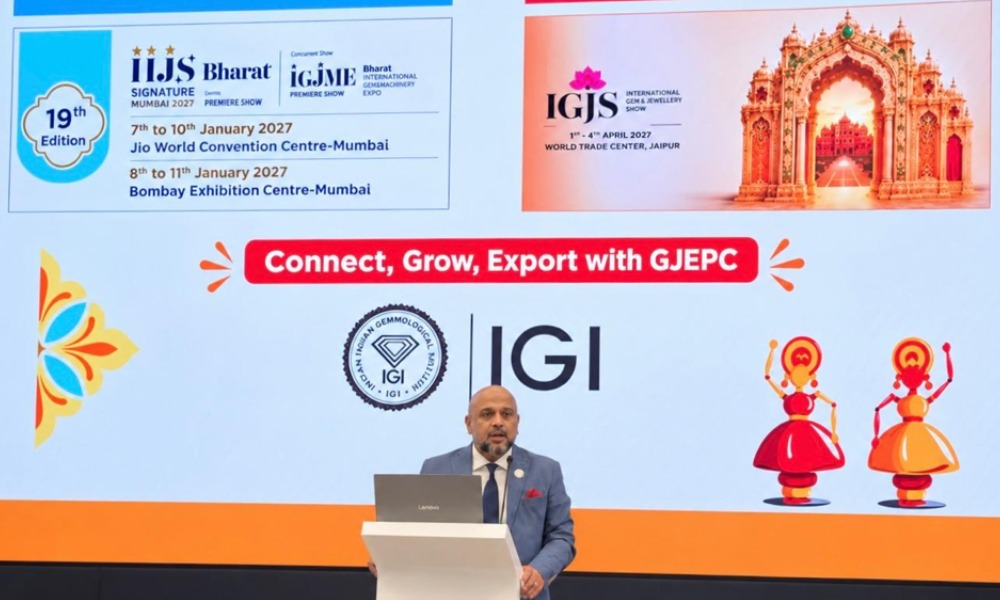
GJEPC stepped up its international buyer outreach for IIJS Bharat – Signature 2027, IGJS Jaipur and IJEX at an industry event organised by the International Gemological Institute (IGI) in Dubai.
Held at the Almas Tower Ballroom in Jumeirah Lake Towers, the IGI Ornamental QC Seminar brought together an audience of more than 70 jewellers, with leading retailers including Jawhara, Joyalukkas, Tajvi, Vinsmera, La Marquise, Bhima and Cara among the expected participants.
Ashish Sakhardande, Head – IJEX, GJEPC, represented the Council and delivered a presentation on its upcoming exhibitions and initiatives, placing particular emphasis on IIJS Bharat – Signature 2027, IGJS Jaipur and IJEX, highlighting its new features and inviting UAE buyers to register for the Mumbai and Jaipur shows.
The UAE remains an important market for Indian jewellery exporters, making direct engagement with retailers and jewellery companies a key part of the buyer mobilisation strategy.
The Dubai event created opportunities for participating Indian exporters to connect directly with potential buyers. Business meetings and networking interactions were facilitated with several UAE-based companies, allowing exporters participating through IJEX to develop new commercial contacts.



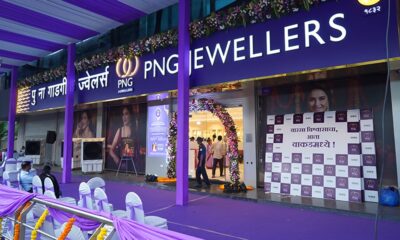
Kangana Ranaut Unveils PNG Jewellers New Showroom In Ayodhya~

GGJS 2026 Concludes With High-Volume Trade and Strategic Focus On Next-Gen Leadership

The Solitaire Festival Of India Concludes; Bumper Prize Winner At Ranka Jewellers Wins XUV 7XO
GGJS 2026 Concludes With High-Volume Trade and Strategic Focus On Next-Gen Leadership

ABARAN Commemorates The 125th Birth Anniversary Of Founder Shri Burde Sadananda Kamath With Special Gold Coin Launch

MCX Gold Silver Futures See Dip
-
 National News2 hours ago
GGJS 2026 Concludes With High-Volume Trade and Strategic Focus On Next-Gen Leadership
-
 National News6 hours ago
ABARAN Commemorates The 125th Birth Anniversary Of Founder Shri Burde Sadananda Kamath With Special Gold Coin Launch
-
 National News6 hours ago
MCX Gold Silver Futures See Dip
-
 National News3 days ago
P N Gadgil Jewellers Limited – Quarterly Update Q2FY27
