National News
Supreme Court Refuses Stay On UPI Charges Above Rs 2,000
MDR Is Neither A Tax Nor A Fee Collected By The Government. Instead, It Is A Commercial Charge Distributed Among Banks, Payment Service Providers, and Other Intermediaries To Sustain Payment Ecosystem Infrastructure.

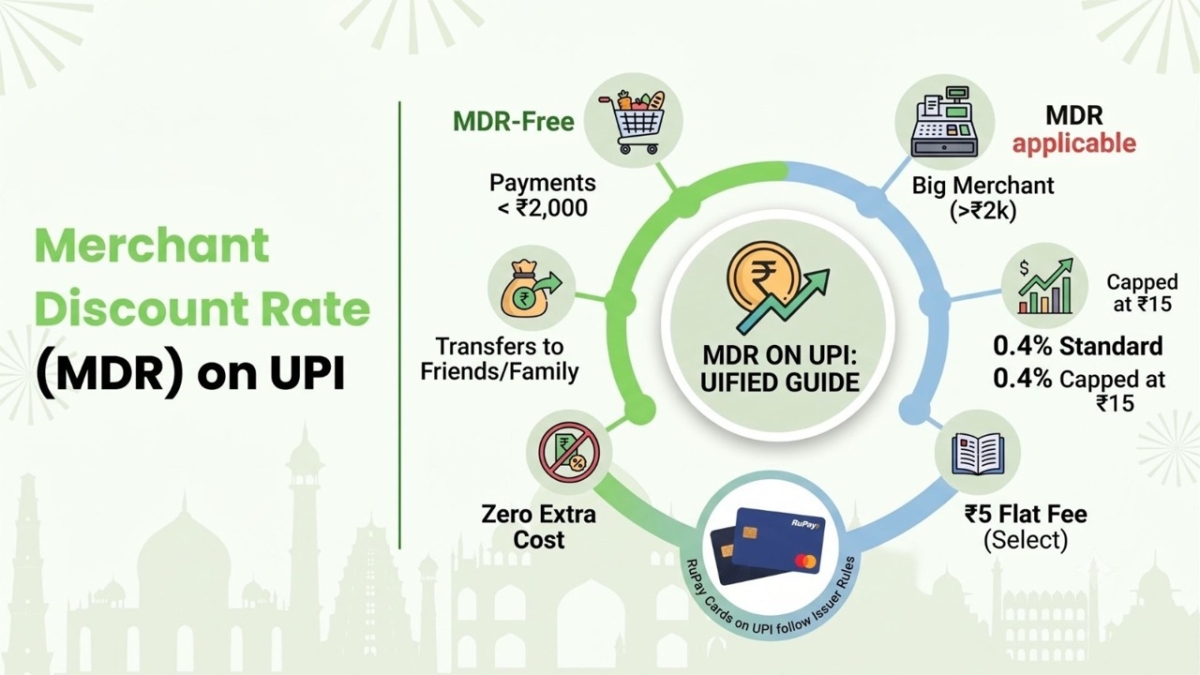
The Supreme Court on declined to grant a stay on the new Merchant Discount Rate (MDR) framework for specified UPI transactions above Rs 2,000. However, a three-judge bench led by Chief Justice of India Surya Kant issued notices seeking responses within four weeks from the Centre, the Reserve Bank of India (RBI), and the National Payments Corporation of India (NPCI) regarding a plea challenging the legality of the charge.
During proceedings on the petition filed by advocate Anjan Datta, Additional Solicitor General N. Venkataraman, appearing for the Centre, clarified that the MDR is neither a tax nor a fee collected by the government. Instead, it is a commercial charge distributed among banks, payment service providers, and other intermediaries to sustain payment ecosystem infrastructure.
Key Details of the New MDR Framework
- Individual-to-Individual (P2P) Transactions: Remain completely free for all amounts.
- Small & Routine Purchases: Merchant payments (P2M) up to Rs 2,000 remain exempt from MDR.
- Standard MDR Rate: A 0.4% charge applies to eligible merchant transactions above Rs 2,000, capped at Rs 300 for payments of Rs 75,000 or higher.
- Small Merchant Exemption: Small merchants receiving up to Rs 1 lakh per month via specified UPI QR codes will continue to enjoy zero MDR. The government estimates that nearly 96% of total UPI merchant transactions will remain unaffected.
- Sector-Specific Flat Fees: Transactions above Rs 2,000 in key sectors—including railways, telecom, fuel, insurance, and agricultural inputs—will attract a flat MDR of Rs 5.
- Capital Markets: Investments in mutual funds, securities
Because jewellery, gold, and high-end electronics fall under standard commercial retail, transactions above Rs 2,000 are subject to the standard 0.4% MDR, subject to the maximum cap of Rs 300. Jewellers and high-value retailers are legally prohibited from passing this fee directly to the buyer as a surcharge or adding separate payment convenience charges.





National News
Gold prices in India extend recovery on softer U.S. dollar, easing Treasury yields, lower crude oil prices.
Market participants attributed the firming metal prices to a pause in U.S. yield gains following strong demand at the latest 30-year U.S. Treasury auction, which relieved pressure on non-yielding assets.

Gold prices in India extended their recovery on Saturday, with 24-carat gold climbing back above the 151,000 rupee mark per 10 grams, supported by a softer U.S. dollar, easing Treasury yields, and lower crude oil prices.
The domestic benchmark rate for 24K gold rose by 710 rupees, or approximately 0.47%, to 151,420 rupees per 10 grams. For bulk purchases, 100 grams of 24K gold stood at 1,514,200 rupees, up 7,100 rupees from the previous session.
Jewellery-grade 22K gold advanced by 650 rupees to 138,800 rupees per 10 grams, while 18K gold climbed 540 rupees to hit 113,570 rupees per 10 grams. Per sovereign (8 grams), 24K gold traded at 121,136 rupees and 22K gold at 111,040 rupees.
The rebound follows a volatile week for bullion. Over the past four sessions, 24K gold has climbed nearly 1.5%, gaining roughly 2,240 rupees from 149,180 rupees on Oct. 6. On the Multi Commodity Exchange (MCX), gold futures rebounded above 151,000 rupees after dipping toward the 149,000 rupee level earlier in the week.
In international markets, spot gold traded near $4,174.78 an ounce after recovering from $4,118.63 in the previous session and briefly breaching $4,200. International spot silver surged over 2% to trade around $60.40 an ounce, driving domestic silver rates in India to approximately 235,000 rupees per kilogram.
Market participants attributed the firming metal prices to a pause in U.S. yield gains following strong demand at the latest 30-year U.S. Treasury auction, which relieved pressure on non-yielding assets.
However, analysts warned that near-term gains may remain capped due to expectations surrounding Federal Reserve monetary policy.The key constraint is the Federal Reserve’s hawkish stance, with policymakers signaling that further tightening may be necessary to bring inflation back to target.



Gold prices in India extend recovery on softer U.S. dollar, easing Treasury yields, lower crude oil prices.

RADIANT REFLECTIONS: The Ultimate Karwa Chauth Edit By Zen Diamond India

Senco Gold & Diamonds celebrates Navratri with festive offers
-

 National News22 hours ago
P N Gadgil Jewellers Limited – Quarterly Update Q2FY27
-

 National News20 hours ago
57th GST Council Recommends Faster Refunds, Lower Penalties and Simpler Compliance
-

 International News20 hours ago
GJEPC’s Paris Buyer-Seller Summit To Be Held From 13–15 October 2026
-

 International News20 hours ago
VICENZAORO Rewards Excellence:The VO Awards Will Be Back For The Second Edition