
National News
SRK’s Sustainability Leadership Recognised With Excellence Award
Recognition Highlights The Growing Role Of Responsible Craftsmanship In The Natural Diamond Industry

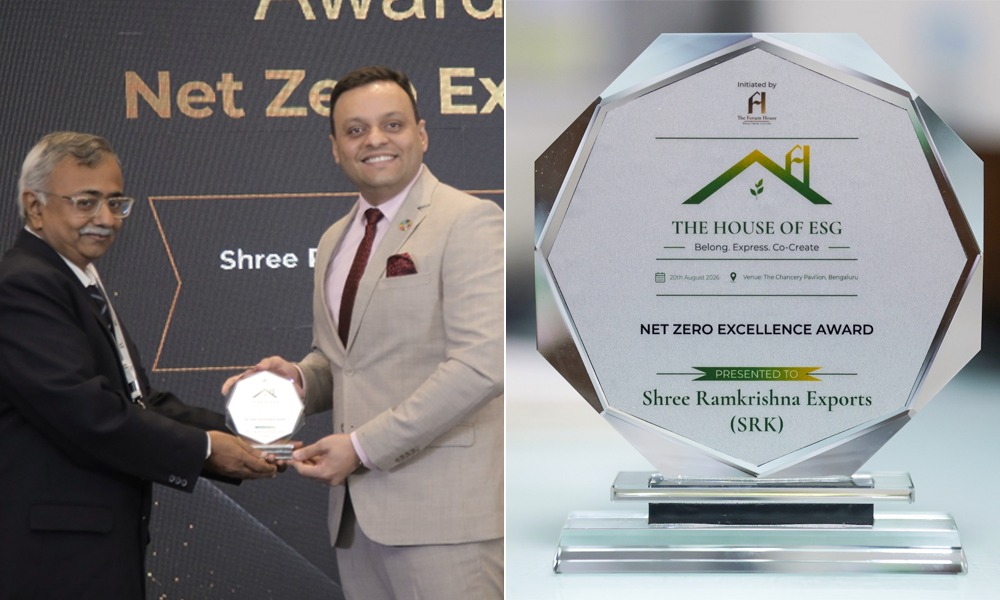
As environmental, social and governance (ESG) considerations increasingly move from voluntary corporate commitments to matters of business resilience, supply-chain responsibility, regulatory scrutiny and stakeholder trust, sustainability is becoming an increasingly important part of how luxury products are evaluated. For the global diamond industry, this evolution is bringing greater attention to the environmental and social performance of the entire value chain, including how diamonds are crafted. Against this backdrop, renowned natural diamond crafting and exports company Shree Ramkrishna Exports (SRK) has been recognised with the “Net Zero Excellence Award” by The Forum House during The House of ESG Summit & Awards 2026, held recently in Bengaluru, India.
The recognition carries particular significance because ‘The House of ESG’ by The Forum House, an executive forum connecting businesses with senior decision-makers and building relationships around meaningful business challenges, brought together CXOs, policymakers, investors, sustainability leaders and industry experts to examine the real-world challenges where sustainability intersects with profitability, supply-chain dependencies and regulatory scrutiny.
Dr. Nirav Mandir, Chief Human Capital and Sustainability Officer, Shree Ramkrishna Exports,Said:

“We are honoured to receive this recognition from The Forum House, particularly because the House of ESG brings together leaders who are actively shaping the next phase of responsible business. For SRK, sustainability has been about building systems, measuring outcomes and creating lasting impact. We believe the natural diamond industry has an opportunity to demonstrate that responsible crafting can be embedded into the product journey itself. This recognition encourages us to continue raising that standard.”
For SRK, the recognition comes after decades of translating sustainability commitments into measurable performance. Both of the company’s flagship LEED platinum certified natural diamond crafting facilities in Surat — SRK Empire and SRK House achieved Net-Zero Energy and Emissions certification in 2024 by Global Network for Zero (GNFZ), an independent, third-party net zero certification body. SRK has subsequently expanded its focus to independently verified Scope 1, Scope 2 and Scope 3 emissions and product-level carbon measurement. SRK’s sustainability journey extends across renewable energy, green-building performance, resource efficiency, water and waste management and carbon sequestration. Through Geeta Vatika, its afforestation initiative, SRK has continued to create measurable carbon-sequestration impact. As per verified carbon sequestration by DQS, Geeta Vatika accounted for approximately 2,929 tonnes of CO₂ in FY2023–24, 3,182 tonnes in FY2024–25 and 4,982 tonnes in FY2025–26.
SRK’s sustainability efforts are also being measured at the level of the diamond-crafting process itself. Its Product Carbon Footprint was independently verified by DQS India. This provides a direct product-level dimension to the sustainability conversation: at the crafting stage covered by the assessment, the carbon sequestration credit exceeded the emissions associated with the core manufacturing process.
The recognition from The Forum House comes at a relevant moment for both SRK and the wider diamond industry. As ESG moves towards greater scrutiny and accountability, the distinction between what a company says about sustainability and what it can demonstrate through data, systems and independently verified results is becoming increasingly important. For SRK, the Sustainability Excellence recognition is an acknowledgement of its approach to embedding sustainability into the way natural diamonds are crafted and a catalyst to continue progressing beyond its Net-Zero milestones towards a broader Net Positive ambition.


National News
IFSCA Notifies India Good Delivery Gold Framework
GJEPC Seeks Swift Rollout and Global Recognition. The Framework Is Expected To Strengthen Responsible Sourcing, Build Confidence In Indian-Refined Gold and Create Opportunities For Bullion Exports.
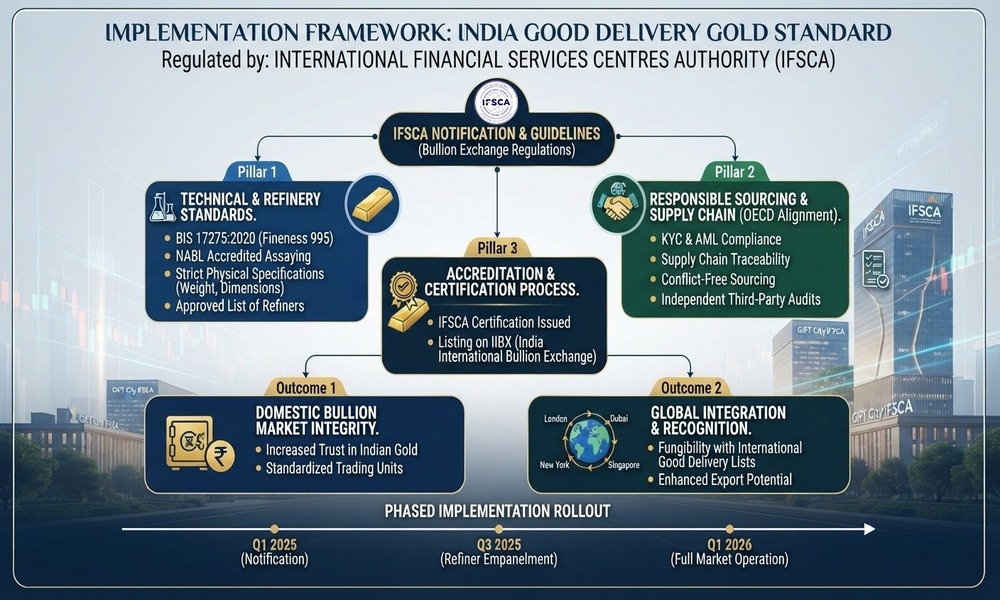
GJEPC has urged the Government to expedite international recognition and the implementation of the India Good Delivery Gold framework, following the notification of the International Financial Services Centres Authority (IFSCA) (Good Delivery) Guidelines, 2026. The framework is expected to strengthen responsible sourcing, build confidence in Indian-refined gold and create opportunities for bullion exports.
The guidelines establish a framework for quality assurance, responsible sourcing and traceability in gold refining. IFSCA, India’s unified regulator for financial products, services and institutions operating in International Financial Services Centres, will implement the framework through the Bullion Exchange in the IFSC. Gold from accredited refiners that meets the prescribed requirements can qualify for delivery on IFSC exchanges and for over-the-counter trading.
The framework extends beyond the purity and quality of gold bars to address their provenance. Refiners must trace raw gold to its source, assess supply-chain risks, verify suppliers and beneficial owners, and meet applicable responsible-sourcing requirements. Independent third-party audits will provide additional assurance.
The initiative follows the recommendations by NITI Aayog, a policy think tank, which had called for an India Good Delivery Standard and responsible-sourcing guidelines for refineries. The report highlighted the potential of domestic refining to retain more value within India, generate employment and support exports.



IFSCA Notifies India Good Delivery Gold Framework

K. Srinivasan Unveils Doit Coimbatore Experience Centre

Kalyan Jewellers’ Navratri Celebrations Bring Stars From All Industries To Thrissur
K. Srinivasan Unveils Doit Coimbatore Experience Centre
Kalyan Jewellers’ Navratri Celebrations Bring Stars From All Industries To Thrissur

World Gold Council Unveils Immersive Gold Experience At Phoenix Palladium, Lower Parel, Mumbai
-
 TechBuzz56 minutes ago
K. Srinivasan Unveils Doit Coimbatore Experience Centre
-
 GlamBuzz2 hours ago
Kalyan Jewellers’ Navratri Celebrations Bring Stars From All Industries To Thrissur
-
 National News2 hours ago
World Gold Council Unveils Immersive Gold Experience At Phoenix Palladium, Lower Parel, Mumbai
-
 National News51 minutes ago
IFSCA Notifies India Good Delivery Gold Framework
