
National News
SMR Jewels Limited’s IPO To Open On May 26, 2026, Price Band Set At ₹ 128 – ₹ 135 Per Equity Share
The Floor Price Is 12.8 Times The Face Value Of The Equity Shares and The Cap Price Is 13.5 Times The Face Value Of The Equity Shares.


SMR Jewels Limited (“Company”) has announced the price band of Rs. 128 to Rs. 135 per Equity Share of face value ₹10 each for its Initial Public Offer of Equity Shares (“IPO” or “Issue”).
The IPO will open on Tuesday, May 26, 2026, for subscription and close on Friday, May 29, 2026.
Investors can bid for a minimum of 2,000 Equity Shares and in multiples of 1,000 Equity Shares thereafter.
The Initial Public Offering comprises a Fresh Issue of 40,00,000 Equity Shares and an Offer for Sale of 9,80,000 Equity Shares by the Selling Shareholders aggregating up to 49,80,000 Equity Shares.
The Equity Shares offered through the Red Herring Prospectus are proposed to be listed on the SME Platform of BSE Limited (“BSE SME”). For the purposes of the Offer, BSE Limited shall be the Designated Stock Exchange.
The Company proposes to utilise the Net Proceeds from the Fresh Issue towards (working capital requirements / funding capital expenditure requirements / repayment of borrowings / general corporate purposes).
SMR Jewels Limited is engaged in the business of designing, manufacturing and marketing gold jewellery products catering to diverse customer preferences and market segments. The Company focuses on blending traditional craftsmanship with contemporary jewellery offering a wide range of jewellery products and focuses on product quality and customer relationships.
The Company operates primarily from Ahmedabad, Gujarat and has developed capabilities across jewellery design, product development and customer servicing. The Company believes its understanding of regional preferences, product quality and customer relationships position it favourably within the organised jewellery market.
The Promoters of the Company are Mr. Vismay Manojkumar Soni, Mr. Jainil Virendra Soni, Mrs. Parul Manoj Soni, Mrs. Dipikaben Virendra Soni and Mrs. Drashti Pal Modi.
The Company’s revenue from operations increased from Rs. 6,752.78 Lakhs in Fiscal 2023 to Rs. 12,452.30 Lakhs in Fiscal 2024, while its profit after tax increased from Rs. 90.94 Lakhs in Fiscal 2023 to Rs. 384.51 Lakhs in Fiscal 2024. Further, revenue from operations increased from Rs. 12,452.30 Lakhs in Fiscal 2024 to Rs. 26,325.18 Lakhs in Fiscal 2025, while profit after tax increased from Rs. 384.51 Lakhs in Fiscal 2024 to Rs. 1,041.23 Lakhs in Fiscal 2025. Additionally, for the period ended December 2025, the Company reported revenue from operations of Rs. 30,872.01 Lakhs and profit after tax of Rs. 1,855.50 Lakhs.
Wealth Mine Networks Limited is the Book Running Lead Manager to the Issue and Purva Sharegistry (India) Private Limited is the Registrar to the Issue.
The Issue is being made through the Book Building Process in terms of Chapter IX of the SEBI (ICDR) Regulations, wherein not more than 50% of the Net Issue shall be available for allocation to Qualified Institutional Buyers, not less than 15% of the Net Issue shall be available for allocation to Non-Institutional Investors and not less than 35% of the Net Issue shall be available for allocation to Retail Individual Investors.


National News
India’s Consul General To Dubai Visits GJEPC Headquarters
GJEPC briefed CG on the Indian gem and jewellery industry’s scale, global leadership in manufacturing, export outlook and the sector’s roadmap for future growth
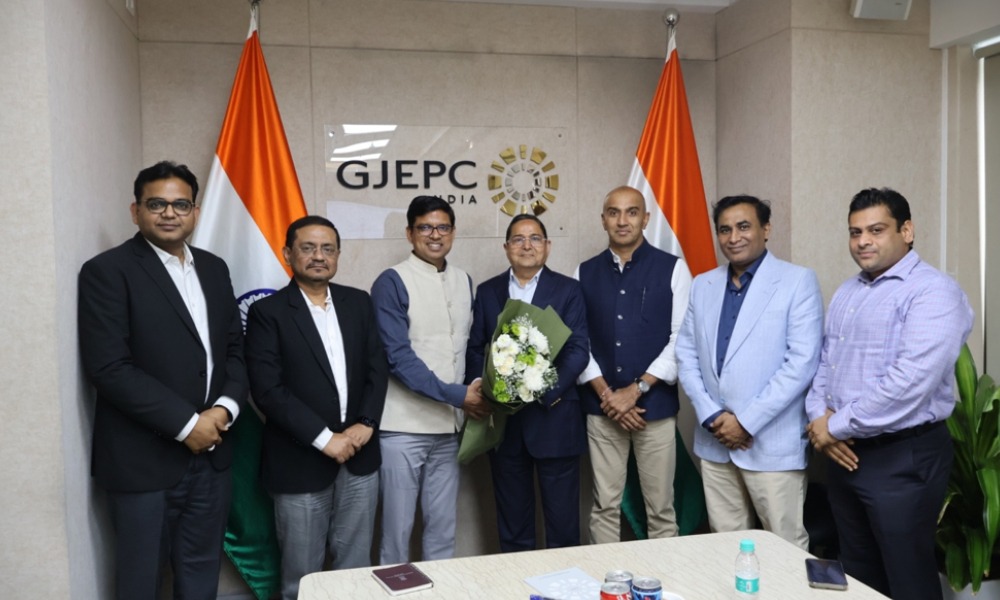
Vishnu Vardhan Reddy, Consul General of India to Dubai, visited the GJEPC headquarters in Mumbai on 24th July for an interaction with industry leaders to gain a deeper understanding of the sector and its engagement with the UAE.
The UAE is India’s largest trading partner in gems and jewellery, with bilateral trade reaching US$33.51 billion in FY2025-26.
The Consul General was welcomed by Kirit Bhansali, Chairman, GJEPC, along with Shaunak Parikh, Vice Chairman; Manish Jiwani, Convenor – MSME; Ashish Borda, Convenor – PMBD; Mital Doshi, Convenor – BITC; Bharat Ghori, Co-Convenor – MSME; and Mr. Sabyasachi Ray, Executive Director, GJEPC.
GJEPC briefed Mr. Reddy on the Indian gem and jewellery industry’s scale, global leadership in manufacturing, export outlook and the sector’s roadmap for future growth. Discussions also covered GJEPC’s role in trade promotion, policy advocacy, international exhibitions and infrastructure development to strengthen India’s position as a global jewellery manufacturing and trading hub.
Given Dubai’s strategic importance to the industry, the meeting focused on the India-UAE gem and jewellery trade ecosystem, evolving supply chains, trade and logistics, banking and financing, and opportunities to deepen bilateral cooperation. The delegation also outlined policy initiatives aimed at enhancing India’s competitiveness in global trading and value addition.
Reddy said the visit provided him with valuable insights into the industry’s priorities and challenges, and expressed his willingness to work closely with GJEPC and the trade to strengthen India’s gem and jewellery partnership with Dubai and the wider UAE.


-
 National News1 day ago
Akoirah by Augmont Celebrates The Family We Choose With A Thoughtfully Curated Friendship Day Gifting Edit
-

 New Premises5 hours ago
GUZEMA Fine Jewelry Opens First U.S. Boutique In New York’s SoHo
-
 International News10 hours ago
De Beers Group Reports H1 2026 Production Surge
-

 International News10 hours ago
Canada Faces 50% US Import Tariffs; Gemstone Exemption Under Review
