National News
PNG Jewellers To Incorporate New Subsidiary, Strengthening Its Supply Chain and Entering Diamond Jewellery Manufacturing
The ₹10 Crore Investment Will Strengthen Backward Integration, Enhance Supply Chain Control and Support The Company’s Studded Jewellery Business and North India Expansion, With PNG Holding A 76% Stake In The New Entity.


P N Gadgil Jewellers Limited (PNG/ PNG Jewellers), one of India’s leading jewellery retailers, today announced its plans to incorporate a new subsidiary marking a significant step towards strengthening its supply chain through backward integration and entering into manufacturing of diamond and gold jewellery.
Deal Overview
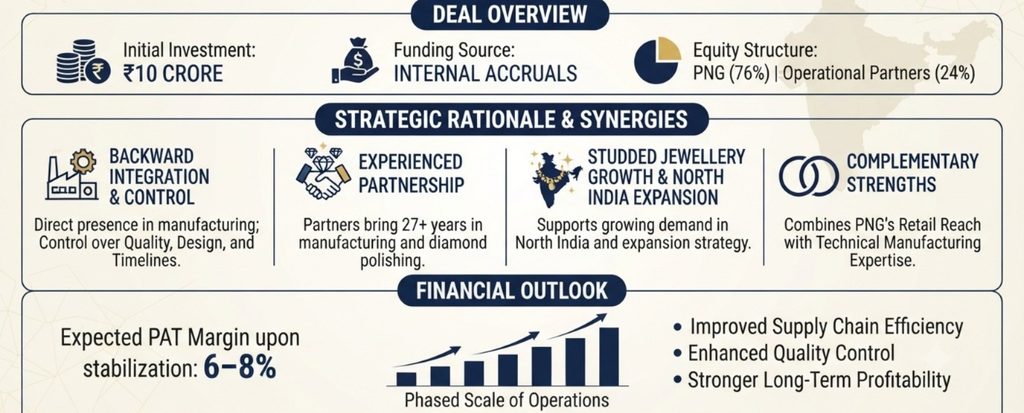
The initial investment towards the project is estimated upto Rs 10 crore, which will primarily be utilized for acquiring the relevant business assets and inventory. The investment will be funded through internal accruals.
The new entity will be incorporated with PNG Jewellers holding a 76% equity stake and the operational partners holding the remaining 24%.
Strategic Rationale & Synergies
1. Backward Integration and Manufacturing Control
This move will provide PNG with a direct presence in diamond and gold jewellery manufacturing, enabling greater control over product quality, design development, procurement and delivery timelines. It will strengthen the company’s ability to respond to evolving consumer preferences while improving operational efficiencies.
2. Established Manufacturing Expertise and Technical Capabilities
The operational partners bring over 27 years of experience in diamond and gold jewellery manufacturing, including diamond cutting and polishing capabilities. Their technical expertise, operational knowledge and manufacturing experience will provide a strong foundation for establishing and scaling the new entity.
3. Strengthening Studded Jewellery Business and North India Expansion
Over the past couple of years, PNG has significantly improved its studded jewellery sales, and with the ongoing expansion in the northern region, this growth is expected to accelerate further. Studded jewellery contributes a relatively higher share of the overall jewellery market in several northern Indian states, which provides a strong rationale for entering into this new venture. This new venture will also support the company’s broader geographical expansion strategy by ensuring access to a wider range of studded jewellery designs and products.
4. Complementary Strengths and Experienced Management
The venture brings together PNG’s established retail presence and the operational partners’ specialised experience in diamond and gold jewellery manufacturing. This combination will give the new entity strong technical expertise from the outset, supported by PNG’s customer reach and brand strength.
Financial Outlook
The subsidiary is expected to achieve a PAT margin of approximately 6–8% upon stabilization. The company intends to scale operations in a phased manner.
The subsidiary is expected to contribute to improved supply chain efficiencies, stronger control over product quality and costs, and enhanced long-term profitability.
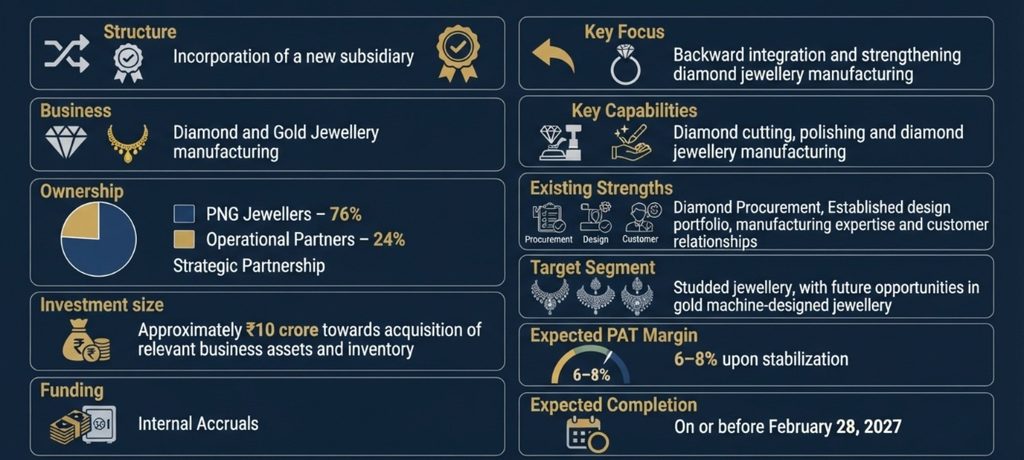
Transaction Snapshot
Management Commentary
Dr. Saurabh Gadgil, Chairman and Managing Director of P N Gadgil Jewellers, said:

“This venture is an important step in our backward integration strategy, marking PNG’s entry into diamond and studded jewellery manufacturing. By combining our established retail network with in-house manufacturing, diamond processing and design capabilities, we will gain greater control over our supply chain, from sourcing to the showroom. This will strengthen product quality and operational efficiency, and help us meet the growing demand for studded jewellery.”
Way Forward
The new entity will commence operations in a phased manner, with an initial focus on acquiring and integrating the relevant business assets, establishing manufacturing operations.
The immediate priorities will include strengthening diamond cutting and polishing capabilities and utilizing PNG’s retail network to create additional business opportunities.
Safe Harbour Statement
Any forward-looking statements about expected future events, financial and operating results of the Company are based on certain assumptions, which the Company does not guarantee the fulfilment of. These statements are subject to risks and uncertainties.
Actual results might differ substantially or materially from those expressed or implied. Important developments that could affect the Company’s operations include a downtrend in the industry, global or domestic or both, significant changes in the political and economic environment in India or key markets abroad, tax laws, litigation, labour relations, exchange rate fluctuations, technological changes, investment and business income, cash flow projections, interest, and other costs. The Company does not undertake any obligation to update forward-looking statements to reflect events or circumstances after the date thereof.


National News
CAG Flags Oversight Gaps In Gold Hallmarking
A Draft Report Finds Over 81% Of Registered Jewelers Went Uninspected Over A FiveYear Period, Prompting Industry Calls For Stricter Enforcement and Upgraded Anti-Counterfeiting Technology

India’s top government auditor has uncovered sweeping enforcement lapses in the country’s mandatory gold hallmarking regime, finding that more than four-fifths of registered jewelry retailers went years without a regulatory inspection
In a draft audit report, the Comptroller and Auditor General of India (CAG) said more than 81% of licensed jewelry shops were not inspected by the Bureau of Indian Standards (BIS) over the preceding five years. Under existing protocols, the BIS—the national standards body—or its authorized assaying and hallmarking centers are expected to conduct annual compliance audits of license holders.
The findings highlight acute regulatory bottlenecks in the world’s second-largest gold-consuming market, where rapid formalization of the retail bullion sector has outpaced oversight infrastructure. According to the report, the BIS cited staffing shortages and inadequate testing facilities for the compliance backlog—an explanation the federal auditor rejected.
Currently, the BIS oversees more than 232,000 registered jewelers nationwide, supported by roughly 1,565 gold hallmarking centers across 392 districts, alongside 327 recognized centers for silver.
Jewelry industry executives said the audit underscores the need to overhaul enforcement logistics, expand testing infrastructure, and deploy stronger anti-counterfeiting technology to protect consumer trust.
Monitoring more than 232,000 registered jewelers with limited BIS resources is a significant challenge, retailers must also bolster internal quality controls and documentation to maintain buyer confidence.
Industry representatives noted that mandatory hallmarking currently covers only about half of India’s districts, leaving substantial geographic gaps.
The All India Gem and Jewellery Domestic Council (GJC) has lobbied regulators to shift mandatory hallmarking from the first point of sale to the final retail point of sale to tighten accountability. Following discussions with trade representatives, BIS officials indicated they plan to ramp up recruitment and market sampling, according to industry participants.
Market insiders also warned that weak physical oversight increases the risk of fraud, particularly regarding the Hallmark Unique Identification (HUID) system—a six-digit alphanumeric code stamped onto each piece of jewelry to allow digital tracking.
Trade body leaders warned of potential duplication of HUID codes and called for more frequent inspections and upgraded technological safeguards. Retailers added that while the hallmarking framework has resolved many legacy purity issues, it continues to face teething troubles that make store reputation critical.
To clear the inspection backlog, industry representatives and trade analysts have advocated for decentralizing the audit process, potentially bringing in third-party auditors and encouraging voluntary compliance disclosures from retailers.
Consumer Safeguards: Five Checks for Gold Buyers
Amid the regulatory scrutiny, jewelry executives and trade representatives outlined five verification steps consumers should take when purchasing gold:
Vet the Retailer: Prioritize established, reputable jewelers, as brand accountability remains a primary safeguard where regulatory inspections lag.
Inspect the Three Mandatory Marks: Confirm that the piece carries the official BIS triangular logo, the stated purity grade (such as 22K916), and a six-digit HUID code.
Verify via the BIS Care App: Cross-check the item’s six-digit HUID on the government’s official BIS Care mobile application to ensure the registered weight, purity, and article description match the physical piece
Audit the Invoice: Demand an itemized tax invoice detailing the HUID, purity, applicable making charges, and—for studded pieces—the net weight of the gold excluding stones.
Retain Documentation for Recourse: Keep the original receipt. Buyers who suspect a purity discrepancy can have the item tested at a BIS-recognized assaying center and file a formal regulatory complaint against the seller if the metal falls short of its stated grade.



PNG Jewellers To Incorporate New Subsidiary, Strengthening Its Supply Chain and Entering Diamond Jewellery Manufacturing

Gold, Silver Stuck Near One-Year Lows As Fed Hike Bets Firm Up :AUGMONT BULLION REPORT

Redefining Fine Jewellery: How Technological Innovation, Haute Couture Synergy, and Avant-Garde Palettes Are Shaping The Festive & Wedding Season
Redefining Fine Jewellery: How Technological Innovation, Haute Couture Synergy, and Avant-Garde Palettes Are Shaping The Festive & Wedding Season

ALROSA Recognizes Cinematic Excellence With Twelve Rare Natural Diamonds
Gold, Silver Stuck Near One-Year Lows As Fed Hike Bets Firm Up :AUGMONT BULLION REPORT
-
 JB Insights1 hour ago
Redefining Fine Jewellery: How Technological Innovation, Haute Couture Synergy, and Avant-Garde Palettes Are Shaping The Festive & Wedding Season
-
 DiamondBuzz4 hours ago
ALROSA Recognizes Cinematic Excellence With Twelve Rare Natural Diamonds
-
 International News37 minutes ago
Gold, Silver Stuck Near One-Year Lows As Fed Hike Bets Firm Up :AUGMONT BULLION REPORT
-

 National News2 hours ago
CAG Flags Oversight Gaps In Gold Hallmarking