

By Invitation
Perspective on Jewellery Manufacturers & Jewellery Making Machinery Manufacturers Industry – 2026
By Bhavik Shah-CEO, DOIT Industries Limited

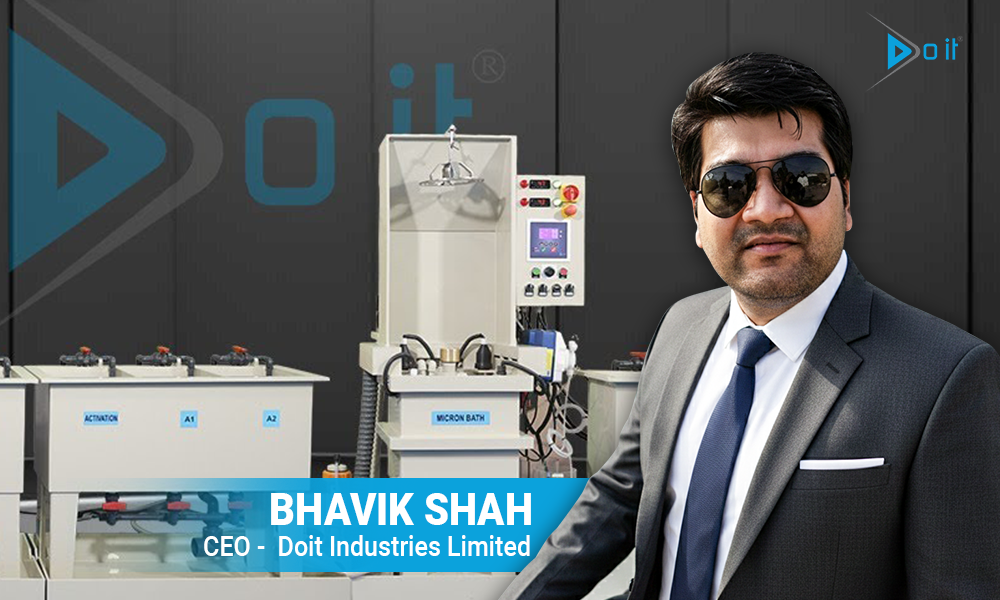
Challenging Market Conditions
The gold jewellery segment is continuously facing a tough year due to high gold prices globally. This has led to reduced affordability & lower consumer demand, especially in price-sensitive markets like India.
At the same time, the market is showing signs of saturation. Gold jewellery is being viewed as a luxury purchase rather than a traditional investment. Quantum-wise, the industry is shrinking as consumers are shifting towards alternate investments and lifestyle experiences.
Emerging Opportunities in Silver
However, every disruption creates an opportunity.
One of the most promising shifts we are witnessing is in silver. Recent restrictions and tighter controls on silver imports have accelerated the need for domestic production. This has created strong demand for advanced jewellery-making machinery capable of delivering high-quality silver jewellery that meets global benchmarks.
Ancillary Industry on the Rise
Jewellery-making machinery manufacturing is emerging as one of the most promising ancillary industries within the jewellery ecosystem.
As manufacturers focus on efficiency and cost optimisation, there is a clear shift towards automation, laser technologies and other. Companies investing in indigenous R&D and technology integration will lead the next phase of growth.
Advanced Tech & Skill Development:
Technology will be the defining differentiator in these sectors. The adoption of CAD/CAM systems, AI-driven design optimisation, automated manufacturing, and digital retail integration is no longer optional—it is essential for scalability and profitability
Skill development is necessary at all times. Advanced machinery and digital tools require a highly trained workforce. Continuous training and upskilling will be essential to improve productivity, maintain quality consistency, and support long-term industry sustainability.
Overall Opinion & View
Looking ahead, with a strong focus on quality, innovation, and global compliance standards, India has a clear opportunity to position itself as a competitive global exporter of jewellery-making machinery over the next decade. While the gold jewellery segment faces both structural and cyclical challenges, the future lies in diversification, technology-led manufacturing, and innovation. Production of lower Karat gold jewellery along with diversifying into alternative metals such as silver, is no longer a choice—it is a strategic imperative.
Jb Exclusive: Digital view


By Invitation
AI is quietly becoming jewellery’s new competitor — and the industry hasn’t realized it yet
Why virtual identity and AI-generated jewellery are beginning to reshape desire by Dr. Sandip P. Dhurat
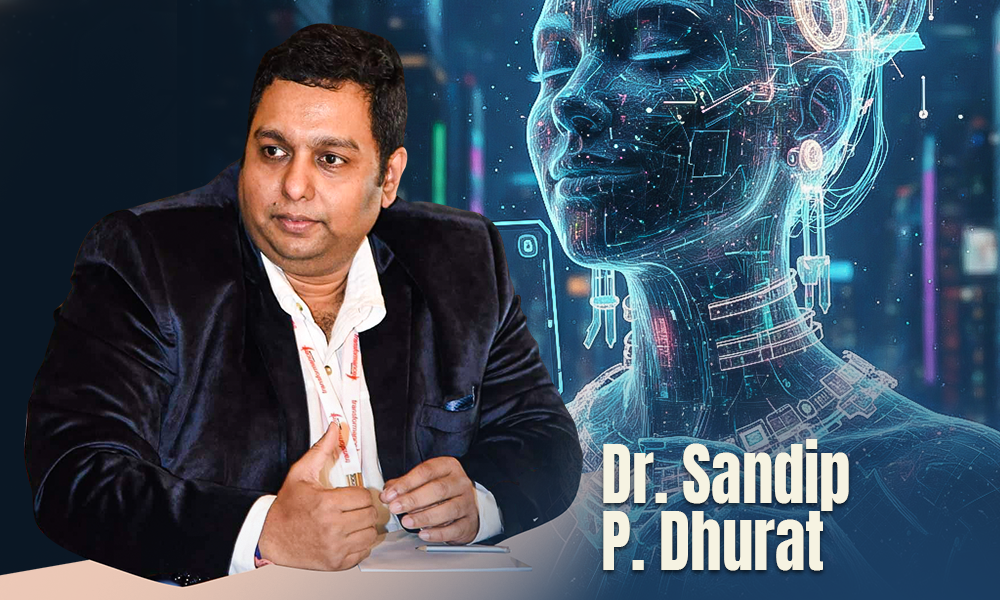
The disruption no one expected
A structural shift is unfolding in the jewellery industry — and it has nothing to do with gold prices, economic cycles, or brand competition.A new competitor has entered the space.It does not mine gold.It does not cut diamonds.Yet it competes directly with what jewellery has always sold.Emotion.
That competitor is Artificial Intelligence.
Until recently, AI was viewed as a support tool — for marketing visuals, catalogues, or design inspiration. But something far more fundamental is happening. AI is beginning to deliver the emotional and aesthetic experience jewellery traditionally provided, without requiring a physical purchase.
This quiet disruption is largely invisible to the industry because it does not look like competition in the conventional sense. Yet its psychological impact is already influencing how consumers engage with jewellery — and whether they feel the need to buy it at all.
The birth of virtual jewellery ownership
For the first time, consumers can “wear” jewellery without owning it.This is not brand-led augmented reality. It is user-driven AI self-imagery.
The process is simple: Upload a photo*Type a prompt*Instantly see yourself wearing any jewellery imaginable*The experience is instant, personalized, and free.
As a result, consumers are now:Creating wedding looks with jewellery they never purchased*Sharing AI-generated selfies wearing diamonds or gold*Curating aspirational online identities*Trying hundreds of designs without stepping into a store
This behaviour satisfies a powerful psychological trigger — the illusion of ownership.
In many cases, that illusion is enough.
The Psychology: AI Is delivering jewellery’s core emotional value
Jewellery has always operated in the psychological domain more than the material one. Its true value lies in: Self-expression*Identity*Beauty*Status signalling*Emotional connection
For the first time, AI can deliver many of these outcomes without a physical object.
Three psychological shifts are particularly significant.
- AI satisfies curiosity instantly: The suspense of “how will this look on me?” — long central to jewellery retail — no longer requires a store visit.
- AI substitutes social gratification: Compliments, validation, and admiration now arrive through virtual appearances shared online.
- AI reduces decision pressure: Trying limitless combinations digitally feels freeing, unlike the emotional weight of choosing in-store.
Together, these shifts quietly reduce urgency — the emotional tension that traditionally drives purchase.
The new consumer journey
Jewellery buying once followed an emotional escalation: Try on Fall in love*Form emotional attachment*Purchase
AI disrupts this sequence by fulfilling emotion earlier.
The new journey increasingly looks like: Curiosity*AI-generated look*Emotional satisfaction*No immediate need to buy
When emotional fulfilment arrives before the point of sale, purchasing becomes optional.
This helps explain patterns many jewellers are observing: High browsing but lower conversion*Longer decision cycles*Increased price sensitivity*Weakening mid-range sales
These are not purely economic signals. They are psychological and technological.
Why softer demand is not just a temporary dip
Across markets, jewellers report softer demand. It is often attributed to macroeconomic uncertainty.
But economics alone cannot explain: Declining impulse jewellery purchases*Gen Z’s weaker attachment to physical jewellery*High engagement with visuals but low buying intent*Growing comfort with virtual luxury experiences
A deeper force is emerging.AI is satisfying the visual and emotional appetite for jewellery without requiring ownership. This does not eliminate jewellery demand — but it dilutes the emotional pressure that once made buying inevitable.
What appears as “slow demand” may actually be the early stage of a structural shift.
Why the industry hasn’t seen this clearly yet
Most brands still see AI as: A design aid*A marketing enhancer*A catalogue generator
Very few recognize it as a substitute for part of the jewellery experience itself. Yet history shows that industries rarely recognize displacement while it is still emotional rather than economic. By the time numbers clearly reflect the shift, behaviour has already changed.
And this raises a far more uncomfortable question. If AI is already replacing part of jewellery’s emotional function — what happens next when it begins to challenge something even more fundamental?
To understand that, the industry must look beyond psychology — and confront a rapidly emerging legal and intellectual battleground. That sounds interesting, isn’t it?
Let’s meet again in the next issue of JewelBuzz for Part 2 of this topic!
Jb Exclusive: Digital view



Perspective on Jewellery Manufacturers & Jewellery Making Machinery Manufacturers Industry – 2026

AI is quietly becoming jewellery’s new competitor — and the industry hasn’t realized it yet

Hari Krishna Group Turns Anniversary into Contribution: 459 Units Donated, Total Blood Collection Reaches 21,863
Perspective on Jewellery Manufacturers & Jewellery Making Machinery Manufacturers Industry – 2026
AI is quietly becoming jewellery’s new competitor — and the industry hasn’t realized it yet
Hari Krishna Group Turns Anniversary into Contribution: 459 Units Donated, Total Blood Collection Reaches 21,863
-
 By Invitation3 hours ago
AI is quietly becoming jewellery’s new competitor — and the industry hasn’t realized it yet
-
 National News21 hours ago
Hari Krishna Group Turns Anniversary into Contribution: 459 Units Donated, Total Blood Collection Reaches 21,863
-
 Appointment1 day ago
KISNA Appoints Nitin Naik as Chief Technology Officer to Drive Digital Innovation and Omnichannel Scale
-

 National News23 hours ago
Jos Alukkas Presents ‘Second Sunrises’
