JB Insights
NITI Aayog Calls For Robust Framework To Boost Gold Exploration & Mining; Cut Import Dependence
The Core Message Is That India’s Gold-Mining Bottleneck Is Not Only Geological Potential; It Is Also The Quality Of Information, The Predictability Of Approvals, and The Credibility Of The Process For Allocating Exploration and Mining Rights.


NITI Aayog CEO Anurag Jain has called for a robust evaluation matrix for awarding gold exploration and mining projects, emphasising the need to draw upon international practices to strengthen India’s domestic gold mining sector.Jain made the remarks during a meeting to discuss the report titled “India’s Gold Mining Policy: Challenges, Learning and the Road Ahead”, prepared by the Pahle India Foundation (PIF) with support from the World Gold Council (WGC).
According to NITI Aayog the proposed evaluation framework is intended to promote technical competence, encourage investment and support the sustainable development of India’s gold resources.
India’s Untapped Gold Potential and Import Dependence
Key Highlights of the Discussions on India’s Domestic Gold Mining Potential
– Untapped Gold Mining Potential: India has considerable untapped gold mining resources but remains heavily dependent on imported gold to meet domestic demand.
– Strengthening Domestic Exploration: Participants emphasised the need to expand domestic exploration and mining capabilities to unlock indigenous gold resources.
– Structural Challenges: Key issues affecting the sector include:
- Inadequate geological data.
- Limited exploration activity.
- Prolonged project development timelines.
- Challenges in auction design.
- Concerns over investment viability.
– Improving Geological Data: Stakeholders called for better-quality and more accessible geological information, supported by internationally accepted reporting standards, to help investors assess mineral potential and project risks.
– Streamlining Regulatory Approvals: Stronger coordination between the Central and state governments was identified as essential to simplify regulatory clearances and reduce project delays.
– Creating a Predictable Policy Environment: Consistent policies and transparent approval mechanisms could improve project bankability and encourage greater private-sector investment.
– Comprehensive Policy Framework: Discussions highlighted the need for an integrated approach addressing technical, regulatory and investment-related barriers to domestic gold exploration and mining.
– Robust Evaluation Matrix: NITI Aayog’s call for a robust evaluation framework aims to strengthen project selection and improve investment conditions in the sector.
– Potential Evaluation Criteria: The proposed framework could assess bidders and projects on:
- Exploration capabilities and geological expertise.
- Financial strength and investment capacity.
- Project feasibility and commercial viability.
- Environmental and social safeguards.
- Project execution capabilities and timelines.
| Challenge identified | Proposed response |
| Inadequate geological data | Adopt internationally accepted geological reporting standards and improve data availability. |
| Limited exploration activity | Encourage technically capable investors through a credible project-evaluation process. |
| Long development timelines | Streamline approvals and improve Centre–state regulatory coordination. |
| Auction-design and viability concerns | Create a predictable policy environment to improve bankability and private participation. |
Policy significance
The core message is that India’s gold-mining bottleneck is not only geological potential; it is also the quality of information, the predictability of approvals, and the credibility of the process for allocating exploration and mining rights. Better geological data would allow investors to assess mineral potential before committing capital, while coordinated approvals could reduce project uncertainty.
What to watch
- Whether NITI Aayog or the Mines Ministry publishes a detailed evaluation matrix, including scoring criteria and weighting.
- Whether India adopts or mandates internationally recognised mineral-resource reporting standards for gold projects.
- Whether states simplify mining-related approvals and align timelines with central clearances.
- Whether subsequent auctions incorporate the proposed technical, financial, and sustainability criteria.
For investors and mining companies, the practical implication is a possible shift toward more structured auctions, clearer technical benchmarks, and greater emphasis on bankable exploration plans. For states with prospective gold belts, stronger Centre–state coordination could become a key determinant of how quickly projects move from exploration to production.




JB Insights
Jewellery Advertising and Promotion Hijacked By AI and Algorithms
From decoding what Gen Z wants before they even know they want it, to conjuring surreal ad campaigns featuring models who don’t have a pulse, tech is rewriting the rules of luxury.

By Steve Fernandes
Forget dusty velvet trays and weeks of agonizing over sketches. The jewellery world—an industry notoriously obsessed with heritage, heavy gold, and “the way we’ve always done it”—just got a massive software update.Artificial Intelligence has officially crashed the atelier. From decoding what Gen Z wants before they even know they want it, to conjuring surreal ad campaigns featuring models who don’t have a pulse, tech is rewriting the rules of luxury.

But while algorithms are churning out prototypes at warp speed, the industry’s heavy hitters are drawing a hard line in the gold dust: AI can crunch the numbers, sure, but only human hands can give a piece a heartbeat.
The Tireless Studio Assistant

Walk into a modern design studio today, and you’re just as likely to see prompt engineering as you are pencil shavings. With gold prices hovering in the stratosphere and lifestyles shifting toward lighter, everyday statement pieces, brands can no longer afford to guess what will sell.
The conversation around AI isn’t about replacing artisans—it’s about removing the guesswork. AI test-drives hundreds of variations in gemstones, proportions, and finishes before a single gram of gold hits the workbench. Instead of looking in the rearview mirror at last season’s sales, AI scours search trends and social chatter to predict the next big silhouette.
Pair AI-driven trend forecasting with next-gen hardware—think 3D printing, paper casting, and electroforming—and you get intricate, feather-light pieces hitting shelves at record speed. Throw in blockchain for airtight traceability, and suddenly, the ancient trade of goldsmithing looks straight out of Blade Runner.
Decoding the Modern Buyer
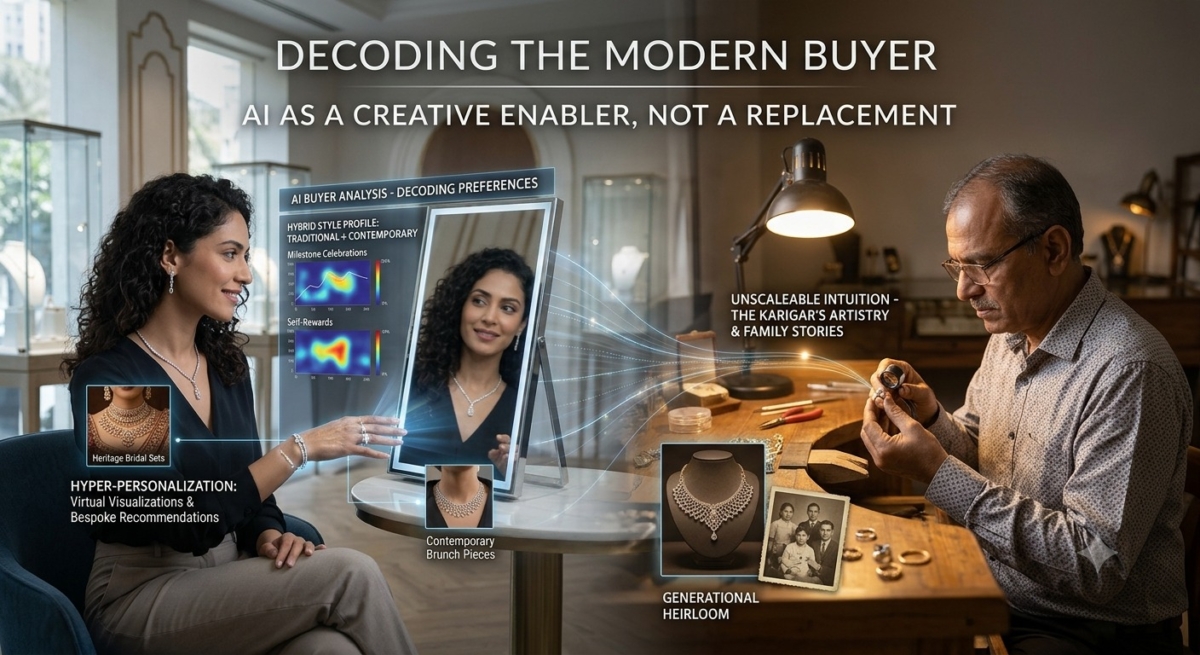
If you think AI is just a backend factory tool, think again. It’s also reading the room—and the customer.
In hyper-discerning markets shoppers want it all: a heritage bridal set steeped in tradition for the wedding, and sleek, contemporary pieces for Monday morning brunch.
By analyzing buyer behavior, AI helps jewellers nail hyper-personalization, offering virtual visualizations and bespoke directions tailored to specific milestones, self-rewards, or celebrations.
Remember: You can’t code the intuition of a seasoned karigar hand-setting a diamond, nor can an algorithm translate a family’s multi-generational story into an heirloom. AI is a creative enabler, not a replacement.
Pixels, Faux-Models,
Of course, the revolution isn’t just happening at the workbench—it’s taking over your feed. Traditional luxury shoots are notoriously brutal on budgets: massive crews, exotic locations, and logistical nightmares. Enter generative AI, slashing content production times by up to 65%.
Brands are ditching physical sets for surreal, dreamlike digital editorials—picture golden heart pendants floating in zero-gravity landscapes—and tapping virtual influencers to front major drops. Just look at Indian label KALON Art Jewellery, which rolled out its “Wildfire” collection starring AI influencer Naisha Bose.
The Glitch in the Glamour

Before we hand the keys of the vault over to our silicon overlords, let’s talk about the catch. For all its swagger, AI still has a glaring blind spot: reality.
Generative algorithms don’t understand physics, metal thickness, or stone-setting mechanics. A ring that looks transcendent on a screen might be structurally impossible to forge in a real workshop without a complete CAD overhaul. Worse, AI still trips over basic human anatomy—nothing kills a luxury vibe faster than a viral campaign featuring a model with six fingers or a warped gemstone.
Then there’s the trust factor. Buying fine jewellery is an emotional, high-stakes flex, and consumers are starting to push back when they realize the radiant model wearing a diamond choker doesn’t actually exist.
The law is catching up, too—New York just passed a landmark regulation forcing brands to slap a disclosure label on ads using “synthetic performers.”
The Verdict
The future of fine jewellery isn’t a cage match between the algorithm and the artisan—it’s a collab. The brands poised to win the next decade are the ones bold enough to let AI handle the heavy lifting of data, speed, and hyper-personalization, while fiercely protecting the raw, messy, irreplaceable magic of human craftsmanship.



NITI Aayog Calls For Robust Framework To Boost Gold Exploration & Mining; Cut Import Dependence

Aspect Bullion & Refinery Partners With PVR To Launch Gold and Silver Vending Machines At Cinemas In Mumbai

Angola Seeking A 10% Stake In De Beers, Scales Back Earlier Ambitions
-

 DiamondBuzz5 hours ago
Natural Diamond Prices Show Split Based On Carat Weight
-
 DiamondBuzz3 hours ago
Angola Seeking A 10% Stake In De Beers, Scales Back Earlier Ambitions
-

 International News5 hours ago
Tiffany and CFDA Name Finalists For Jewelry Designer Award
-
 National News3 hours ago
Aspect Bullion & Refinery Partners With PVR To Launch Gold and Silver Vending Machines At Cinemas In Mumbai