
International News
Jewellery Was The Top Category For Global Luxury Spending In 2025: Bain & Company-Altagamma
Fundamental Shift in luxury consumption—from ownership to meaningful experiences, AI-driven shopping journeys

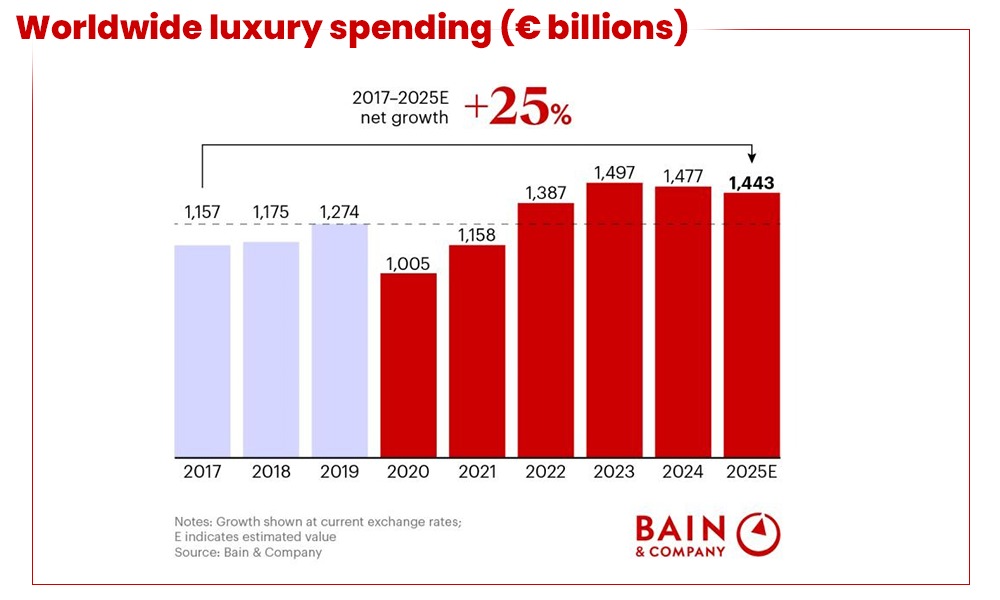
Despite economic uncertainty, geopolitical tensions, and changing consumer behaviour, the global luxury industry is showing signs of stabilization. According to the Bain & Company–Altagamma Luxury Goods Worldwide Market Study 2026, global luxury spending reached €1.443 trillion in 2025, with the personal luxury goods market expected to return to moderate growth in 2026. Jewellery was the top category for global luxury spending in 2025
The report highlights a fundamental shift in luxury consumption—from ownership to meaningful experiences, AI-driven shopping journeys, and greater demand for personalization. Brands that succeed will be those that strengthen cultural relevance, embrace AI, and deliver emotionally engaging experiences.
Key Highlights
- Global luxury spending reached €1.443 trillion in 2025 and is projected to grow 0–2% in 2026.
- The personal luxury goods market stood at €358 billion in 2025 and is expected to grow 2–4% in 2026, reaching €365–373 billion.
- Luxury experiences continue to outperform tangible goods, reflecting consumers’ preference for memorable experiences over ownership.
- Jewellery is the strongest-performing luxury category, followed by apparel, eyewear, and fragrances.
- Leather goods, footwear, and cosmetics remain under pressure, though recovery is gradually emerging.
- The Americas, led by the US, are driving growth, fuelled by younger consumers and expanding upper middle-class spending.
- Europe and the Middle East continue to weigh on market performance due to weaker tourism and geopolitical uncertainty.
- China is showing cautious recovery, with online luxury sales rising 25–35%, driven more by fashion than status-led purchases.
- Around 60% of luxury brands are now outperforming last year’s results, indicating improving market resilience.
- Nearly 50% of luxury shoppers consult the second-hand market before purchasing new products, underlining the growing importance of resale.
- Artificial Intelligence is transforming luxury retail, with half of consumers already using AI during their purchase journey for discovery and product comparison.
- More than 80% of the luxury market’s value is represented by brands that actively invest in sports sponsorships to build cultural relevance.
- Immersive luxury experiences—including bespoke travel, fine dining, and local cultural experiences—continue to gain popularity.
- Consumers increasingly associate luxury with personal fulfilment and meaningful living, rather than status or social recognition.
- Bain identifies three priorities for luxury brands:
- Deliver immersive, experience-led luxury.
- Build stronger cultural relevance across diverse consumer groups.
- Leverage AI for personalization and co-creation with customers.
The luxury industry is entering a new phase where growth will be driven less by products and more by experiences, emotional connections, AI-enabled personalization, and authentic brand meaning. While macroeconomic and geopolitical challenges remain, brands that adapt to evolving consumer expectations are well positioned for sustained growth.




International News
U.S. specialty jewellery retailers recorded a 5.7% y-o-y revenue increase in Sept 2026:Tenoris
The growth continues to be driven primarily by high-end purchases rather than sales volume. Average consumer spend per item jumped 11% in September, offsetting an 11% drop in sales volume for lower-priced merchandise.

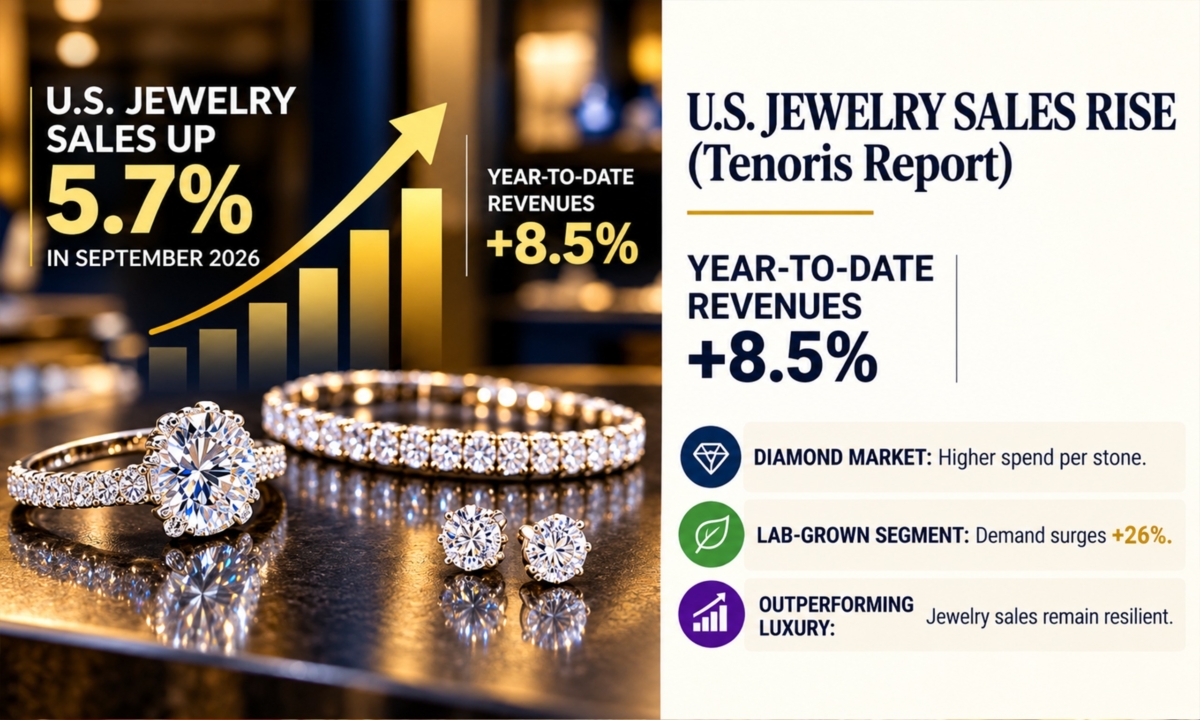
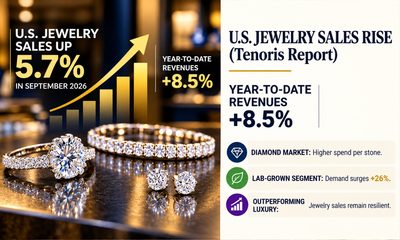
U.S. specialty jewelry retailers recorded a 5.7% year-over-year revenue increase in September 2026, extending nearly two years of continuous monthly growth despite broader economic headwinds, according to new data from industry analytics firm Tenoris. Year-to-date jewelry revenues are now up 8.5%.
The growth continues to be driven primarily by high-end purchases rather than sales volume. Average consumer spend per item jumped 11% in September, offsetting an 11% drop in sales volume for lower-priced merchandise.
Key insights from the September report include:
- Diamond Market Dynamics: Sales of finished diamond jewelry dipped slightly by 0.6%, though average spending per stone rose 11%.
- Lab-Grown Segment: Demand for lab-grown diamond jewelry surged nearly 26% year-over-year. However, revenue for loose lab-grown diamonds fell for a fifth straight month due to declining prices.
- Outperforming Broader Luxury: While overall U.S. luxury spending fell 6% in September—according to recent Citi credit card data—jewelry sales remained comparatively resilient, driven by affluent buyers.
When overall revenue increases even as the number of individual items sold drops, it creates a optical illusion of growth. On paper, top-line financial performance looks strong, but underneath, the business is relying on fewer transactions at much higher prices.Heading into the high-volume fourth quarter—driven by holiday shopping—this dynamic presents specific operational challenges and strategic risks for jewelry retailers.



U.S. specialty jewellery retailers recorded a 5.7% y-o-y revenue increase in Sept 2026:Tenoris

GJC lauds GST 2.0, says it is landmark reform that ushers in a new era of trust, transparency, for GJ sector

Titan Jewellery portfolio posts 21% yoy growth in Q2 FY27
-
 National News2 days ago
P N Gadgil Jewellers Limited – Quarterly Update Q2FY27
-

 National News2 days ago
57th GST Council Recommends Faster Refunds, Lower Penalties and Simpler Compliance
-
 BrandBuzz16 hours ago
9 Special Gemstones for this Navratri By Irasva Fine Jewellery
-
 International News15 hours ago
U.S. specialty jewellery retailers recorded a 5.7% y-o-y revenue increase in Sept 2026:Tenoris
