
JB Insights
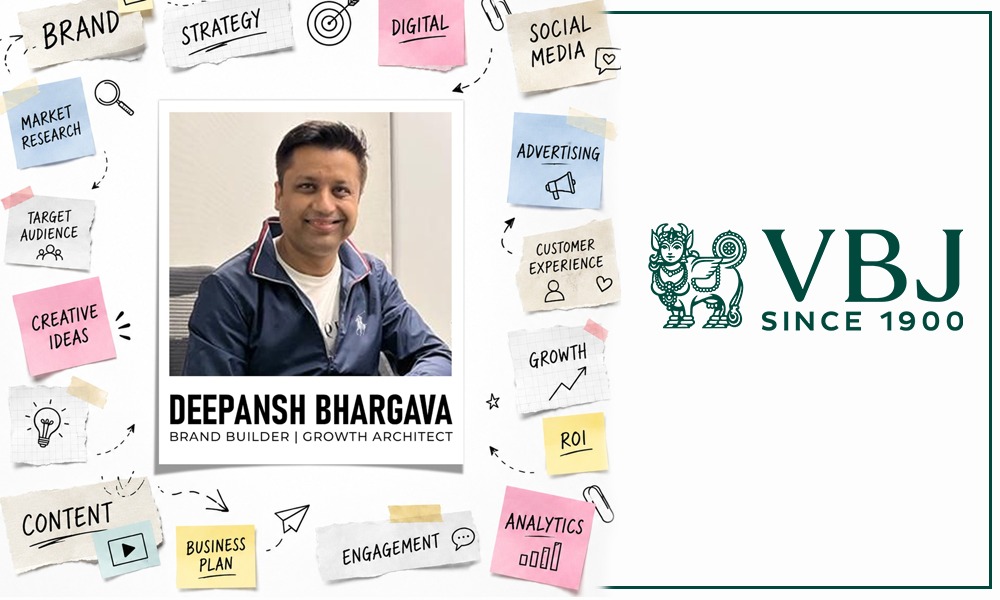
From Customer Intelligence To Autonomous Growth Intelligence: Deepansh Bhargava Senior Vice President & Head Marketing at VBJ
From Customer Intelligence To AI-powered Growth Decisions, The Next-Gen CDP Is Built To Create Measurable Incremental Value.

For the last 6 years, Customer Data Platforms have transformed how brands understand their customers. They have brought fragmented data together, created unified customer profiles, enabled segmentation and made personalisation more intelligent. But the next evolution of CDPs will not be defined by how much customer data they can organise. It will be defined by how intelligently AI can convert that data into consumer value and incremental business outcomes.
The shift is from Customer Intelligence to Growth Intelligence.
Businesses today know more about their existing customers than ever before their purchase history, frequency, preferences, lifetime value and likelihood of buying again. Yet the larger opportunity lies in moving beyond what customers did to understanding what they need next, where their behaviour is changing and where the next phase of growth will come from. This also requires a sharper focus on incrementality.
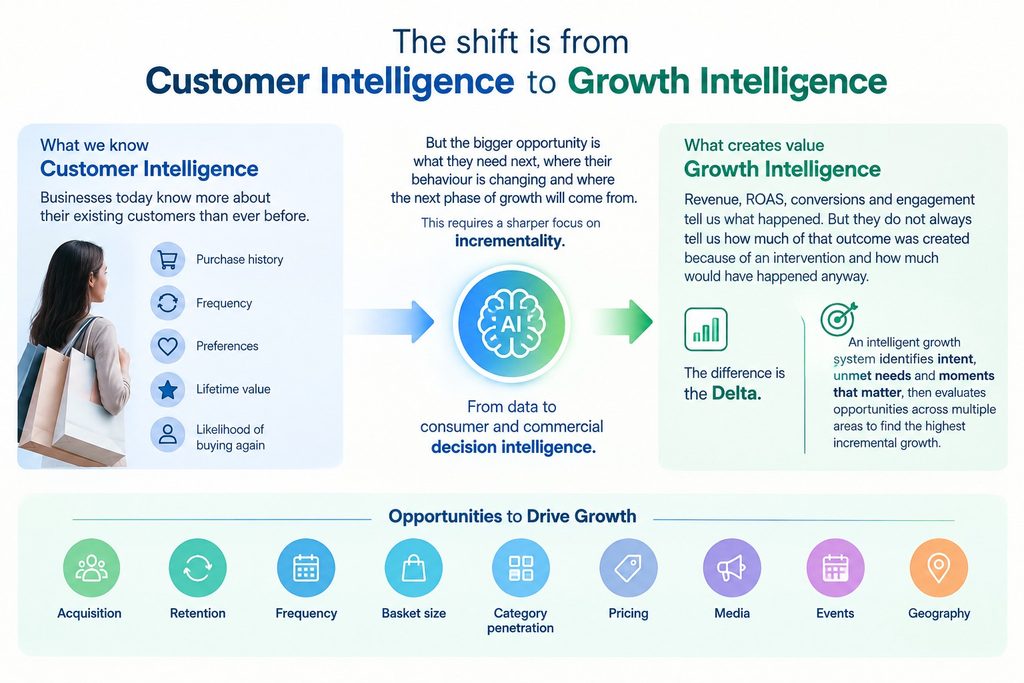
Revenue, ROAS, conversions and engagement tell us what happened. But they do not always tell us how much of that outcome was created because of an intervention and how much would have happened anyway.
That difference is the Delta. AI can help take CDPs beyond systems of customer intelligence and turn them into systems of consumer and commercial decision intelligence. Instead of simply identifying customers with a high propensity to purchase, an intelligent growth system could identify intent, unmet needs and moments that matter then evaluate opportunities across acquisition, retention, frequency, basket size, category penetration, pricing, media, events and geography to identify where the highest incremental growth opportunity lies.
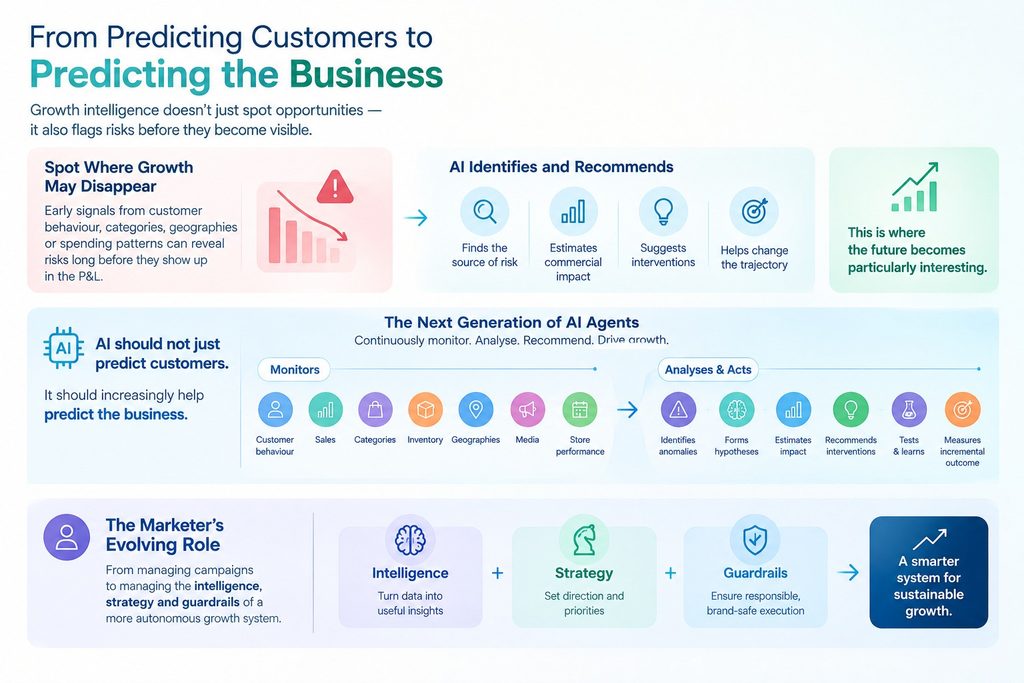
Growth intelligence should also help businesses identify where growth is likely to disappear. Early signals from customer behaviour, categories, geographies or spending patterns could reveal risks long before they become visible in the P&L. AI could identify the source of the risk, estimate its potential commercial impact and recommend interventions to change the trajectory. This is where the future becomes particularly interesting.
AI should not just predict customers. It should increasingly help predict the business.
The next generation of AI agents could continuously monitor customer behaviour, sales, categories, inventory, geographies, media and store performance. They could identify anomalies, form hypotheses, estimate commercial impact, recommend interventions, test them and measure the incremental outcome.
The role of the marketer would evolve from simply managing campaigns to managing the intelligence, strategy and guardrails around a more autonomous growth system.
This evolution can be built around three principles: Anticipate, Act and Account.
1. Anticipate where consumer needs and growth will emerge and where they may disappear.
2. Act by identifying and eventually executing the most relevant intervention for the consumer and the business.
3. Account for whether that intervention genuinely created incremental value.
The CDP of the future, therefore, should move beyond being a platform that simply manages customer data. It should become a Growth Decision Platform one that helps businesses understand consumers better, identify opportunities, detect risks, recommend actions, measure incrementality and continuously learn from every intervention. The ultimate measure of such a platform should not be the volume of data it manages.
It should be much simpler:
Show me the Delta you create.
Because ultimately, consumer centricity is not the opposite of growth. It is where sustainable growth begins.





JB Insights
Jewellers Expect Healthy Festive and Wedding Demand Amid Evolving Consumer Preferences
India’s jewellery industry is entering the festive and wedding season with cautious optimism, supported by positive consumer sentiment, relatively stable bullion prices and sustained demand for wedding-led purchases.


India’s jewellery industry is entering the festive and wedding season with cautious optimism, supported by positive consumer sentiment, relatively stable bullion prices and sustained demand for wedding-led purchases. While elevated gold prices are influencing buying behaviour, jewellers expect lightweight designs, contemporary styling, natural diamonds and innovative bridal collections to drive sales.
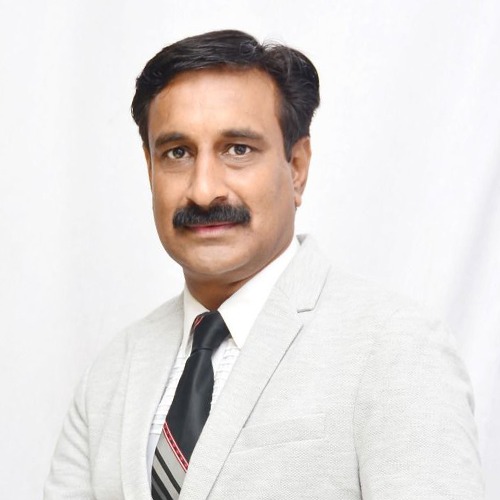
Vinay Bamalwa, Director, Nemichand Bamalwa and Sons, said consumer sentiment remains positive, with gold prices staying range-bound over the past three to four months. Sentiment towards natural diamonds has also improved over the last 12–18 months. The company’s 2026–27 Eden bridal collection has received an encouraging response, reinforcing expectations for the season.
Anil Kataria, Director, DP Abhushan Ltd., see favourable conditions for jewellery sales. He cited positive consumer sentiment and conducive gold and silver prices as encouraging factors. We see a positive sentiment in consumers, and foresee healthy sales in the festive season. We are optimistic we will meet our targets this festive season.
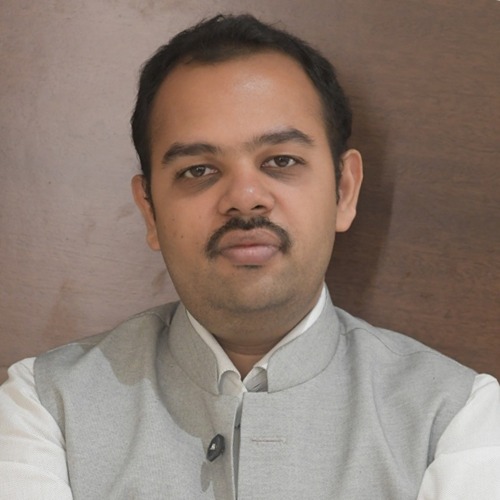
Vaibhav Saraf, Director, Aisshpra Gems & Jewels, expects healthy festive and wedding demand despite elevated gold prices, noting that customers are becoming more thoughtful and value-conscious. Lightweight, versatile jewellery is gaining preference, while bridal buyers increasingly seek statement pieces offering multiple styling options. The company has introduced Navni, a diamond bridal collection featuring innovative 9-in-1 jewellery designs, alongside contemporary and everyday-wear offerings.
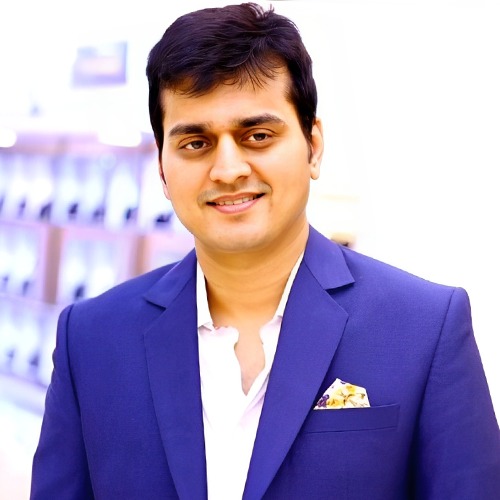
Vastupal Ranka, Director, Ranka Jewellers, said current gold and silver prices are creating a favourable backdrop for jewellery sales. “We are seeing strong consumer sentiment and anticipate healthy demand leading into the festive season. While volume may see a slight dip, we remain confident that customers will continue to buy with optimism,” he said.
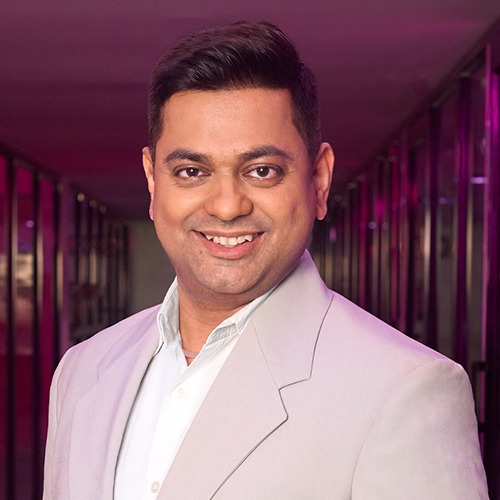
Darshan Chauhan, Whole-time Director, Sky Gold & Diamonds Ltd., expects wedding-led consumption, cultural traditions and demand for design-led, value-conscious jewellery to support the season. He highlighted the importance of inventory efficiency, faster stock rotation, consistent quality and market-relevant designs in helping retailers capture seasonal opportunities.
Vijay Pokharna, Founder, Pure Platinum Jewellery Pvt. Ltd., expects platinum jewellery to gain momentum as consumers increasingly favour premium, contemporary and meaningful purchases. Beyond traditional occasions, everyday luxury and self-purchase—particularly among younger consumers—present significant growth opportunities. He emphasised that innovation, accessible products, compelling designs and greater consumer awareness will be crucial to expanding the category.

Overall, industry leaders expect a healthy festive and wedding season, with success increasingly dependent on design innovation, value perception, product differentiation and efficient inventory management. Rather than signalling a retreat in jewellery demand, changing consumer preferences are creating opportunities for brands and retailers to broaden their offerings and strengthen customer engagement.



Aisshpra Gems & Jewels Opens Four Stores in One Day, Takes Network to 20; Targets 30 Stores by March 2028

The Met Goes Desi: Inside Sabyasachi’s Showstopping Diwali Dhamaka in New York

Jewellers Expect Healthy Festive and Wedding Demand Amid Evolving Consumer Preferences

Dhanteras Shopping Guide 2026:Gold, Silver, Diamonds & Festive Jewellery Trends To Watch

From Diya Puja To Diwali Soirées: Jewellery Designed To Go Beyond The Festive Season

Indriya, Aditya Birla Jewellery Unveiled India’s Largest Sustainable Jewellery Rangavalli
-
 JB Insights1 day ago
Dhanteras Shopping Guide 2026:Gold, Silver, Diamonds & Festive Jewellery Trends To Watch
-
 BrandBuzz1 day ago
From Diya Puja To Diwali Soirées: Jewellery Designed To Go Beyond The Festive Season
-
 National News1 day ago
Indriya, Aditya Birla Jewellery Unveiled India’s Largest Sustainable Jewellery Rangavalli
-

 BrandBuzz1 day ago
The Solenne Collection: A Celebration Of Diwali By Bharti Bangur Fine Jewels
